 |
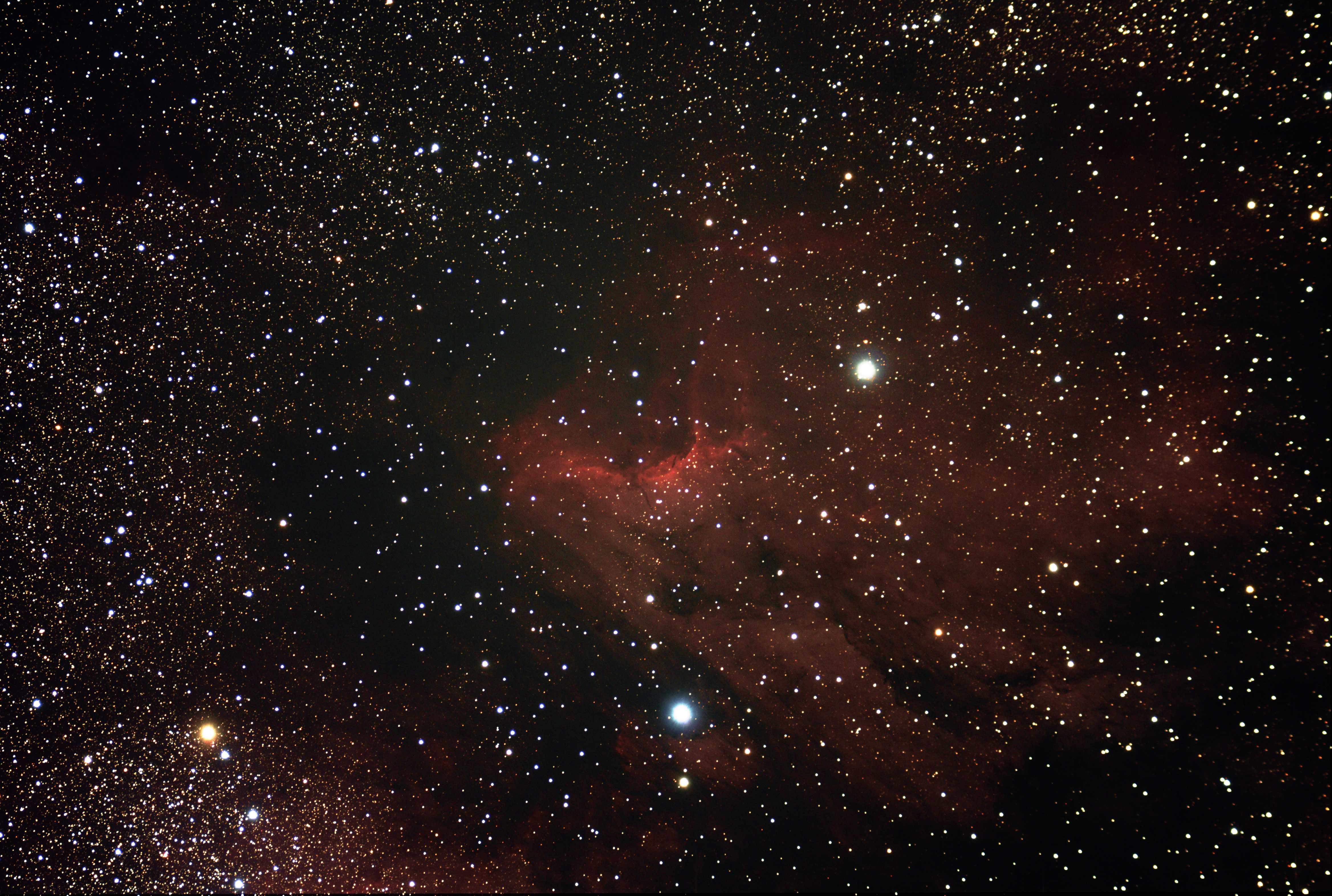
45. IC 5070 Pelican Nebula
Notes: This image could be the medieval town of Talberg, which was smothered in pink fog by Nebel, the evil genius who lived in the high crags of Mt. Griza.1 Looking eastward this month of July into the plane of The Galaxy at 40 degrees of declination in the direction of Cygnus, we find numerous interstellar clouds of gas, dust, or a combination of the two. Through a small telescope with a modified2 DSLR camera and multiple long exposures of say 5 to 10 min, they appear as unexplored mystical realms enveloped in pink mist and partly shrouded by black clouds. The North America Nebula (NGC 7000), with the Cygnus Wall and Pelican Nebula, is prominent. These appear to all belong to a single system that includes a less dramatically structured region designated IC 5068, the Pelican's Rest, which itself is sometimes broken down into smaller patches.
The clouds of gas are mainly hydrogen. The dark clouds of dust between the nebulae and ourselves are made up of clumps of molecules, including organic molecules. Since the hydrogen gas both reflects and emits light under the influence of radiation from stars, we see these objects referred to as reflection-emission nebulae or often just emission nebulae. Wikipedia says of IC 5070 The light from young energetic stars is slowly transforming cold gas to hot and causing an ionization front gradually to advance outward. When hydrogen is ionized by ultra-violet light from stars, electrons are boosted up to the third energy level and then fall back to level two or one. About half of them fall to level two, and in the process, they emit photons of H-alpha light at the wave length of 656.28 nm.
Also in the neighborhood are less dense objects, including the Veil supernova remnant (NGC 6992 and 6960), the Crescent (NGC 6888) emission nebula, and the Cocoon (IC 5146) nebulae. Under the influence of neighboring stars or of their own internal stars, their clouds of hydrogen gas emit light, which appears red or pink in long-exposure DSLR images taken without filters.
Such immense quantities of gas raise the question of where it all comes from. It is thought that the Crescent Nebula was initially formed by a red giant that began off-gassing between 400,000 and 250,000 years ago, about the time that early humans were making stone hand-axes with finely knapped blades. It is still off-gassing, but at higher velocities. Ultra-violet radiation from the originating star and/or from the shock waves produced where the high velocity gases hit the slow ones is what stimulates the visible emissions and reflections. This is not an expansive and inclusive interstellar gas cloud like the North America, but neither is is a supernova remnant like the Veil. The two clouds of the Veil are remnants of a supernova that occurred near the beginnings of recorded human history some 8000 to 5000 ya (Wikipedia).
What about the origin of the complex that includes the North America Nebula, the Cygnus Wall, the Pelican Nebula, and IC 5068? Because of the immense sizes of the gas clouds, it seems unlikely that they are produced entirely by off-gassing giant red stars like the central star of NGC 6888. More likely they derive from less dense parts of the original gas clouds of The Galaxy or its progenitors. The most dense regions precipitated The Galaxy's billions of stars relatively quickly. The remaining gases continue to contract and create localized star-forming regions. Radiation from newly forming stars expands these clouds and pushes out streams of gases. Well, that's what it looks like from Nevada City. These wild speculations are subject to revision as we encounter reliable information.
The Cocoon Nebula has the look of a supernova remnant, but it appears to have formed differently from the remnants and from the Crescent in that it formed from a preexisting cloud of gas. About 100,000 years ago, a new star formed within a nebula and blew out a hole in the gases. According to Nemiroff and Bonell, it is at the same time, an emission nebula, a reflection nebula, and an absorption nebula.
Table 1 presents the distances, sizes, and apparent magnitudes of two emission nebulae in Cygnus, but the Pelican is included as a part of the North America. Perhaps the main thing to be gained from the table is that the system lies within a zone extending from 1600 to 1800 Ly from the Sun. This system and the three nebulae in Table 2 can be located around the left anterior quadrant of Cygnus. The nebulae in Table 2 appear to have quite different origins each involving the evolution of a single star within the lifetime of archaic Homo sapiens and human cultures. The figure for the span of NGC 7000 includes IC 5070.
Table 1. The North America system of emission nebulae in Cygnus
| ID | Name | Span Ly | Dist. (Ly) | Arcmin | Ap. Mg. |
|---|---|---|---|---|---|
| NGC 7000 | N. America | 100 | 1600±100 | 120x100 | 4 |
| IC 5070 | Pelican | 35 | 1800 | 60x50 | 8.0 |
The nebulae in Table 2 appear to be of different species altogether from those in Table 1. The main points of similarity are their locality in or near Cygnus within our neighborhood of the Orion Arm of The Galaxy and the fact that they emit strongly in the H-alpha band. But the nebulae in Table 2 originate in mid-Pleistocene winds from a star that began blowing some 400,000 to 250,000 years ago (NGC 6888), the formation of a new star within a nebula 100,000 ya (IC 1546), and the explosion of a star only 8,000 to 5,000 ya (NGC 6992, 6960). In all three cases, the nebula originated in the activity of a single star. The supernova of the Veil has caused it to expand the distance between its two visible clouds, which far exceeds the spans of the older Cocoon and the much older Crescent. The span of the Veil remnants equals the span of the North America.
Table 2. Three star-created nebulae in Cygnus
| ID | Name | Span Ly | Dist. (Ly) | Arcmin | Ap. Mg. |
|---|---|---|---|---|---|
| NGC 6992, 6960 | Veil | 100 | 1470 | 120 | 7.0 |
| NGC 6888 | Crescent | 30 | 5000 | 18x12 | 7.4 |
| IC 5146 | Cocoon Nebula | 15 | 3300 | 12 | 7.2 |
The information on the formation of the listed nebulae of various types appears in Table 3.
Table 3. Origins of five nebulae in Cygnus neighborhood
| ID | Name | Origin |
|---|---|---|
| NGC 7000 | N. America | remnant from Galaxy precipitation |
| IC 5070 | Pelican | part of North America |
| NGC 6992, 6960 | Veil | supernova remnants |
| NGC 6888 | Crescent | off-gassing star creates high pressure zone of emission |
| IC 5146 | Cocoon Nebula | new star blew hole in existing nebula |
Footnotes
1. Pink Fog. Unpublished ms. Luther P. Gerlach.
2. infrared filter removed
Technical Notes: The subexposures for this image were long (10 min to 12.5 min) and used the high ISO number of 16. Discussions with Tony Finnerty and a closer reading of Jerry Lodriguss' book on disk* have convinced us that we need to change our ways. We should greatly shorten the subexposures by carefully using the histogram as a guide to whether the signal to noise ratio is adequate. The payoff for shortening the subexposures should be to reduce whatever component of the noise is produced by heat generated by the camera. It also seems likely that we can get better detail in the faintest regions by reducing ISO to 800, because gains in brightness at 1600 are accomplished by binning pixels, not by brightening up each pixel. We may be able to get more detail, more brightness, and lower noise by taking many subs of shorter duration over longer total integration times. We shall see.
*A Guide to Astrophotography with Digital SLR Cameras
Zoom in/out with ⌘↑(+/-) (Mac), ctrl (+/-) (PC).