 |
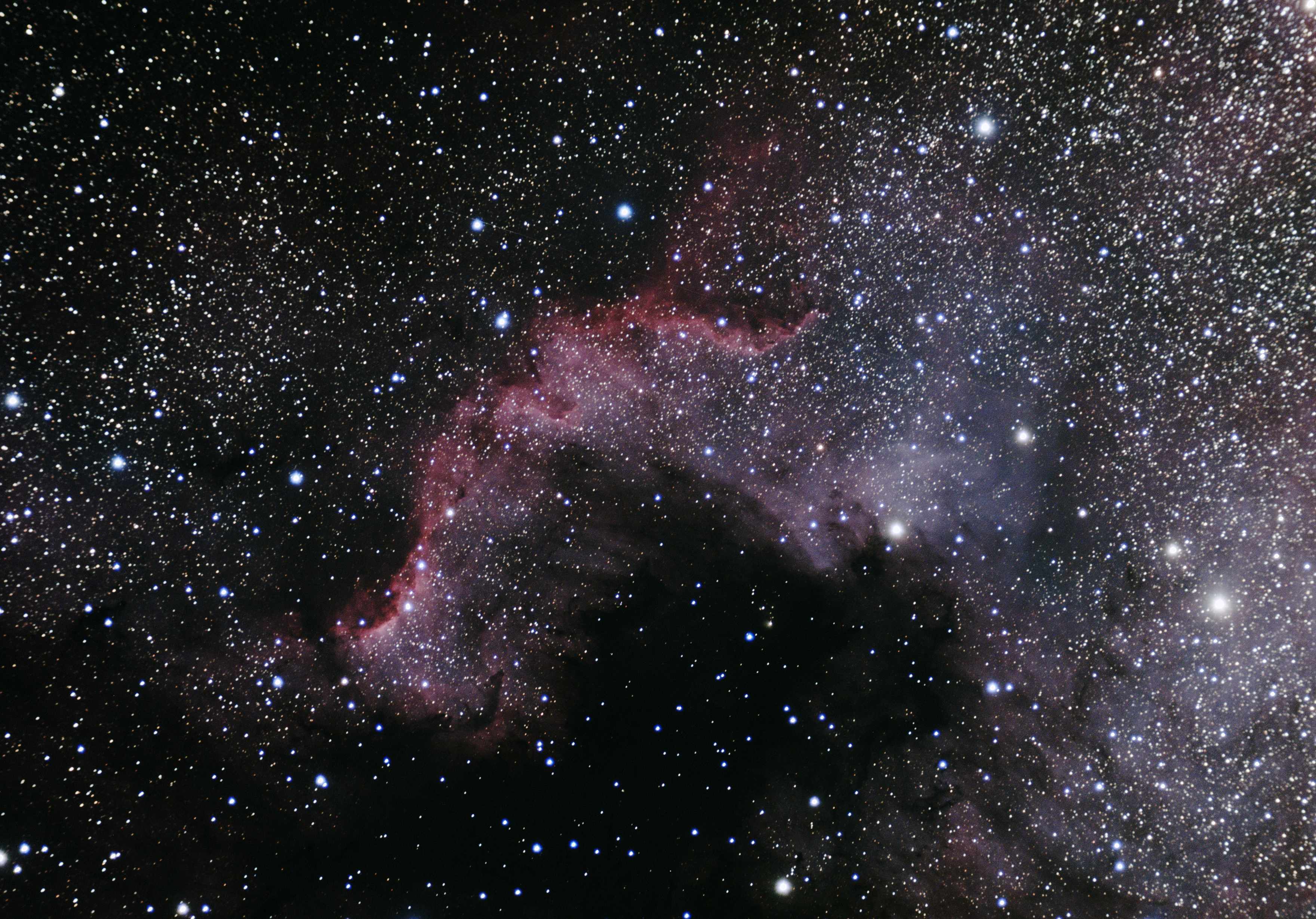
34. Cygnus Wall in NGC 7000 North America Nebula
Notes: Why is the Cygnus Wall bright on one side and dark on the other? Perhaps because light shines on it from the bright neighboring stars on the east side. Our field of view is large enough to capture most of the cloud named NGC 7000, but this is only part of a much larger complex that occupies 6 degrees of arc with the Pelican nebula (IC 5070). The Cygnus Wall may reveal a shockwave in which new stars are forming (David Jurasevich). Close observation with a tight zoom reveals that a satellite or cosmic ray passed across the upper half of the field of view.
Technical Notes: Given the physical characteristics of our site, this is an ideal time of year to image this object. We were able to image for about 4 hours each night between 7:00 pm and 11:00 pm. On the 5th, we spent most of that time watching the election returns. We are experimenting with longer exposures, which means fewer exposures per night and more nights imaging. The results from the first night with 10 subexposures were grainy. Much of the grain disappeared in the stack of 23 images from two nights.
The Orion Nebula (13) also has apparent magnitude 4. We imaged Orion at ISO 400, 1 min per subexposure, and 16 subexposures. It doesn't make sense that two images of magnitude 4 can be imaged at such different levels and times of exposure. An image of Orion with 20 min subexposures would be entirely overexposed in the center. Each pixel in the camera would be struck by 40 times as many photons. Zoom in/out with ⌘↑(+/-) (Mac), ctrl (+/-) (PC).