 |
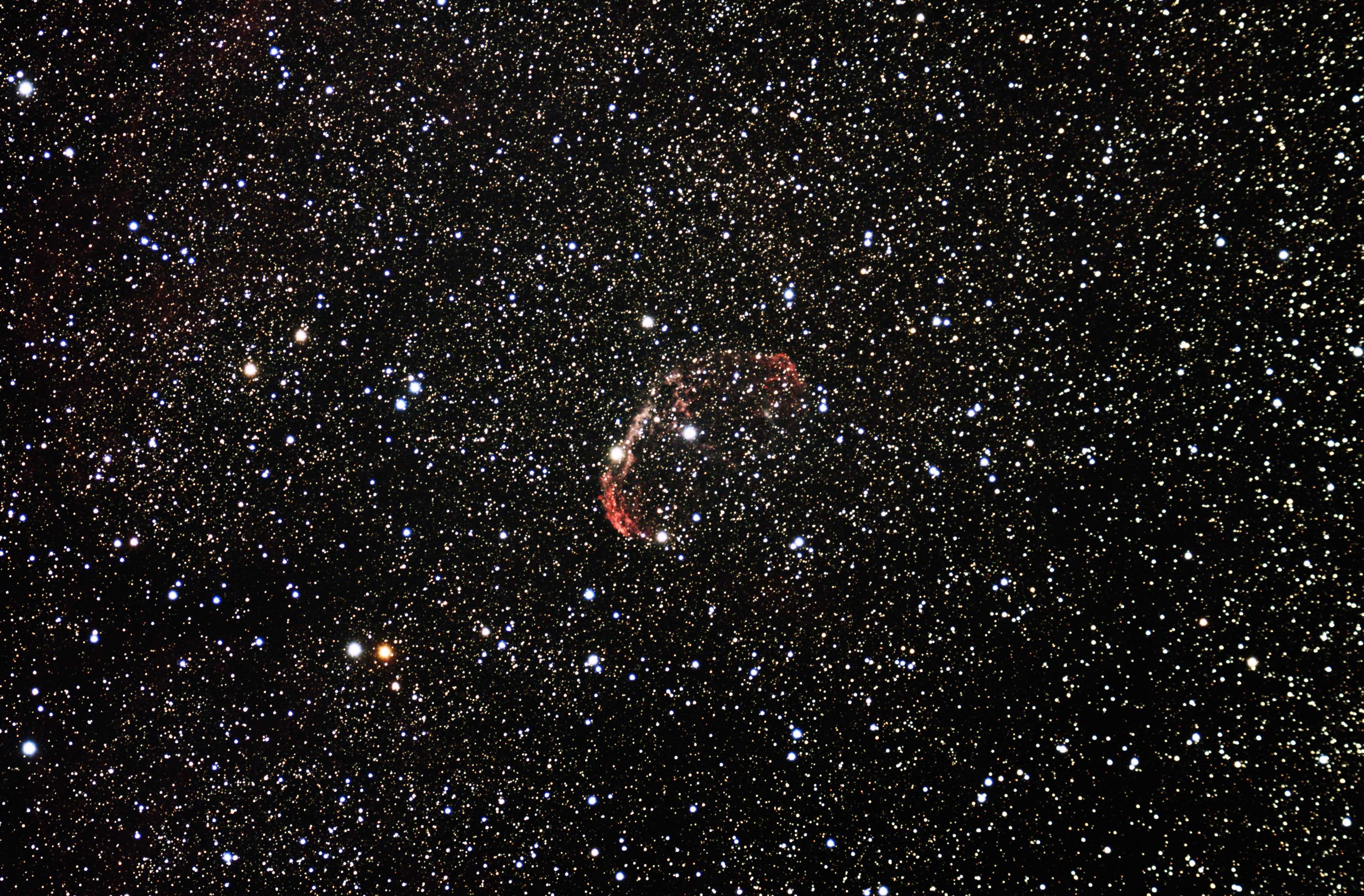
44. NGC 6888 (Caldwell 27) Crescent Nebula
Notes: The stars are abundant because we are looking directly into the plane of The Galaxy in the constellation Cygnus. NGC 6888 is very near the central star γ Cygnus. If we finish calibration of the telescope mount with Deneb, the slew to 6888 is only a bit more than the width of our image frame.
Roughly 250,000 to 400,000 years ago, about the time that prehistoric humans known as Homo heidelbergensis were learning how to knap stones into well-shaped hand-axes (Figure 1), and perhaps also to speak a proto-language, a star in this neighborhood of The Galaxy became a red giant.

Figure 1. Acheulian hand-ax, from Klein, R. G., The Human Career: Human Biological and Cultural Origins, 3rd Ed., Chicago, 2009.
Since The Galaxy is 150,000 light years in diameter and NGC 6888 is only 5000 light years distant, this giant was in our neighborhood. It was the same, still massive, star that we see centered in the image of the nebula—WR 136.

Figure 2. WR 136
The red giant that was to become WR 136 ejected a wind described only as slow moving by Wikipedia (Crescent Nebula, viewed July 8, 2013). If we subtract the 5000 years it takes for light to reach us, putting us in the Early Dynastic period of Egyptian civilization, we can say that presently, WR 136 is giving off a high velocity stellar wind that is colliding with that ancient slow wind from mid-Pleistocene times. One might think that this collision is the source of the visible emissions of Hydrogen-alpha light that show up as red in our image, but that is not the case. According to Wikipedia, the collision produces a shell and two shock waves, one moving outward and one moving inward. The inward moving shock wave heats the stellar wind to X-ray-emitting temperatures. Somehow, still unexplained in detail, hydrogen atoms are also stimulated to emit light. In a paper by C. J. Wareing et al. in the Monthly Notices of the Royal Astronomical Society we find the following:
The accepted theory of planetary nebula (PN) formation is the interacting stellar winds model (ISW) (Kwok 1982; Balick 1987) where a fast wind (∼ 103 km s−1) from the hot central star of a PN blows into the slow wind (∼ 10km s−1) produced during the preceding asymptotic giant branch (AGB) phase. The inner regions of the slow wind are compressed into a dense shell and ionised by the energetic UV radiation of the central star. The familiar ring-like appearance of PNe is then observed. Structures in the nebula are normally attributed to asymmetries in the slow wind, related to physical properties of the central star, such as rotation or binarity. (http://arxiv.org/pdf/astro-ph/0512028.pdf, viewed 19/7/2013)
The two descriptions agree on the collision of the fast and slow winds, but they seem to disagree on the dynamics of the collision and ionization. Other wave lengths not visible in this image are from Oxygen III and Sulfer as seen in this image by the Finnish astrophotographer J-P Metsavainio. The nebula is about 25 light years across. With a large aperture telescope we would see a bubble rather than a crescent shape. According to NASA, the nebula and its nurse star may not be with us much longer: Burning fuel at a prodigious rate and near the end of its stellar life this star should ultimately go out with a bang in a spectacular supernova explosion. We hope to see it soon, or is 5000 light years not a safe distance?
Technical notes: Although dim objects are challenging or impossible with small telescope, the short focal length (570 mm) has a real advantage in making it easier to achieve precise tracking. When the seeing conditions are good, as they were for these observations, the relatively inexpensive CGEM displays excellent tracking and produces round stars over 10 minute exposure times. We also see the advantage of living in the Sierra Nevada foothills of northern California, where rural skies are dark and one can observe several nights running. On the other hand a telescope with a wider aperture, such as an 11 inch reflector, combined with an Ha or OIII filter, would probably fill in the nebula bubble. Zoom in/out with ⌘↑(+/-) (Mac), ctrl (+/-) (PC).