 |
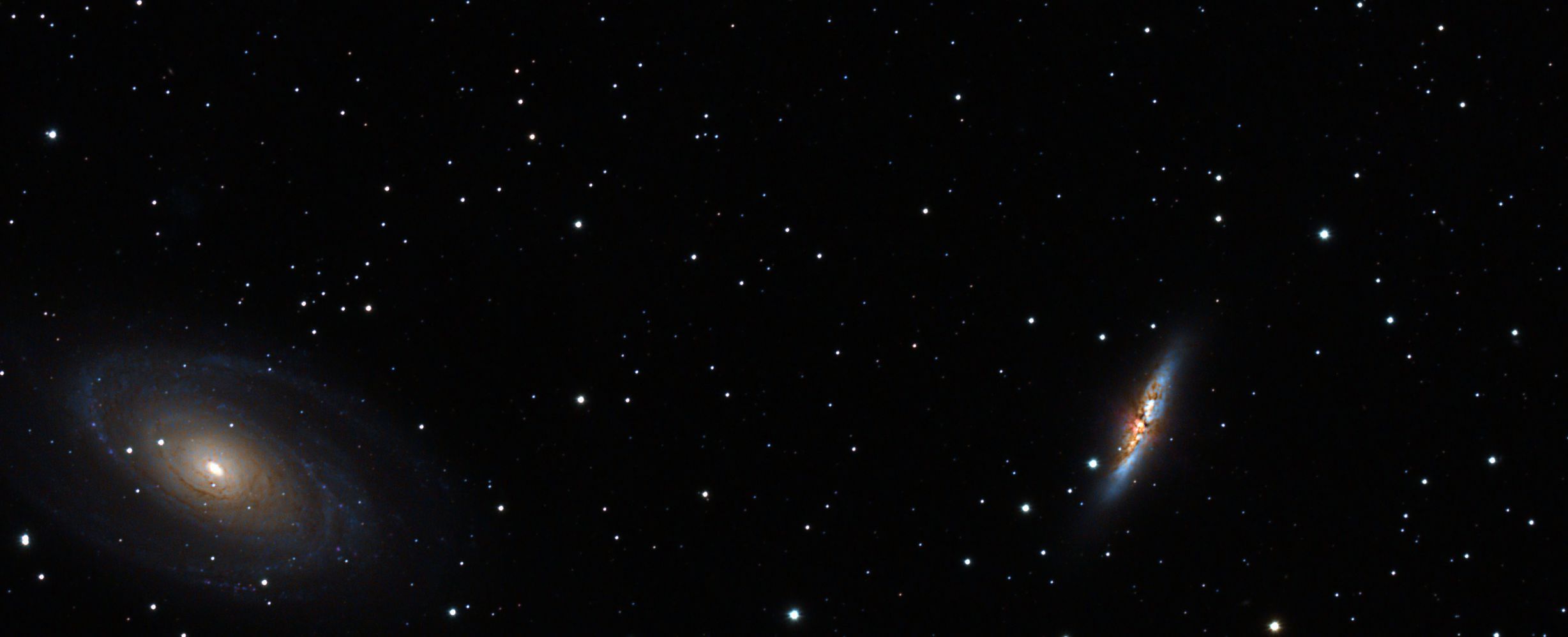
58. M82 starburst galaxy (right) with M81 Bode's Galaxy (left)
Notes: In April, these two galaxies are found right in your own back yard in the northern part of the constellation Ursa Major. We imaged M82 hoping to catch some hint of the supernova of January, 2014 (See Bright new supernova blows up). Bodes Galaxy came along for free, as the field of view of a 110 mm telescope is about two full degrees in width and the galaxies line up horizontally. There is obviously no bright supernova in the image of M82, but there is what appears to be a reddish lump in the same location. Could it be a remnant of SN2014?
We can expect M82 to produce another nova every 10 years or so. The strong gravitational influence from M81 is helping to drive star formation in M82.1 The diameter of M82 is about 1/4 that of the Milky Way, but it's luminosity is five times greater.2 The distance between the centers of M81 and M82 is roughly 130,000 ly. The Milky Way at the same distance might just fit into our image and cover both M81 and M82. There are about a dozen visible interesting lumps in this image of M82.
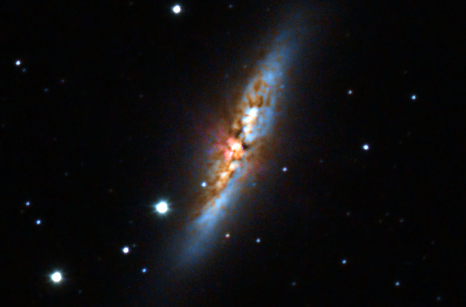 Figure 1. Zoom of M82 showing structures. |
We are not sure what they are, but new globular clusters are known to be forming near the core.2 The red skirt around M82 is dust radiating in the infrared and visible red.
Tammy Plotner has published an interesting theory that perhaps bears on the lumps we see in our image. She quoted E. R. Seaquist et al.3
"The compact nonthermal sources in M82 and other starburst galaxies are generally thought to be supernova remnants (SNRs). We consider an alternative hypothesis that most are wind-driven bubbles (WDBs) associated with very young super star clusters (SSCs). In this scenario, the synchrotron-emitting particles are produced at the site of the shock transition between the cluster wind and the hot bubble gas. The particles radiate in the strong magnetic field produced in the expanding shell of shocked ambient interstellar gas.” says E. R. Seaquist (et al), “One of the motivations for this hypothesis is the lack of observed time variability in most of the sources, implying ages greater than expected for SNRs, but comfortably within the range for WDBs. In addition, as SNRs these sources are not effective in driving the starburst mass outflow associated with the nuclear region of M82, thus requiring a separate mechanism for coupling supernova (SN) energy to this outflow."
The paragraph is coupled with the image in Figure 2:
 Figure 2. Image from Plotner's article |
Plotner's discussion pertains to "compact nonthermal sources" and we are seeing large objects in the visual spectrum, but if the nonthermal sources are producing wind, hot bubbles, and interstellar gas, what we see may be a result.
For our previous effort, done in 2012 soon after obtaining our astroimaging equipment, see item 12.
1. Wikipedia, Messier 81, Messier 82.
2. Barker, S., R. de Grijs, and M. Cervino, Star cluster versus field star formation in the nucleus of the prototype starburst galaxy M82. arXiv:0804.1913v1 [astro-ph] 11 Apr2008.
3. M82, http://www.universetoday.com/47071/messier-82/
Zoom in/out with ⌘↑(+/-) (Mac), ctrl (+/-) (PC).