 |
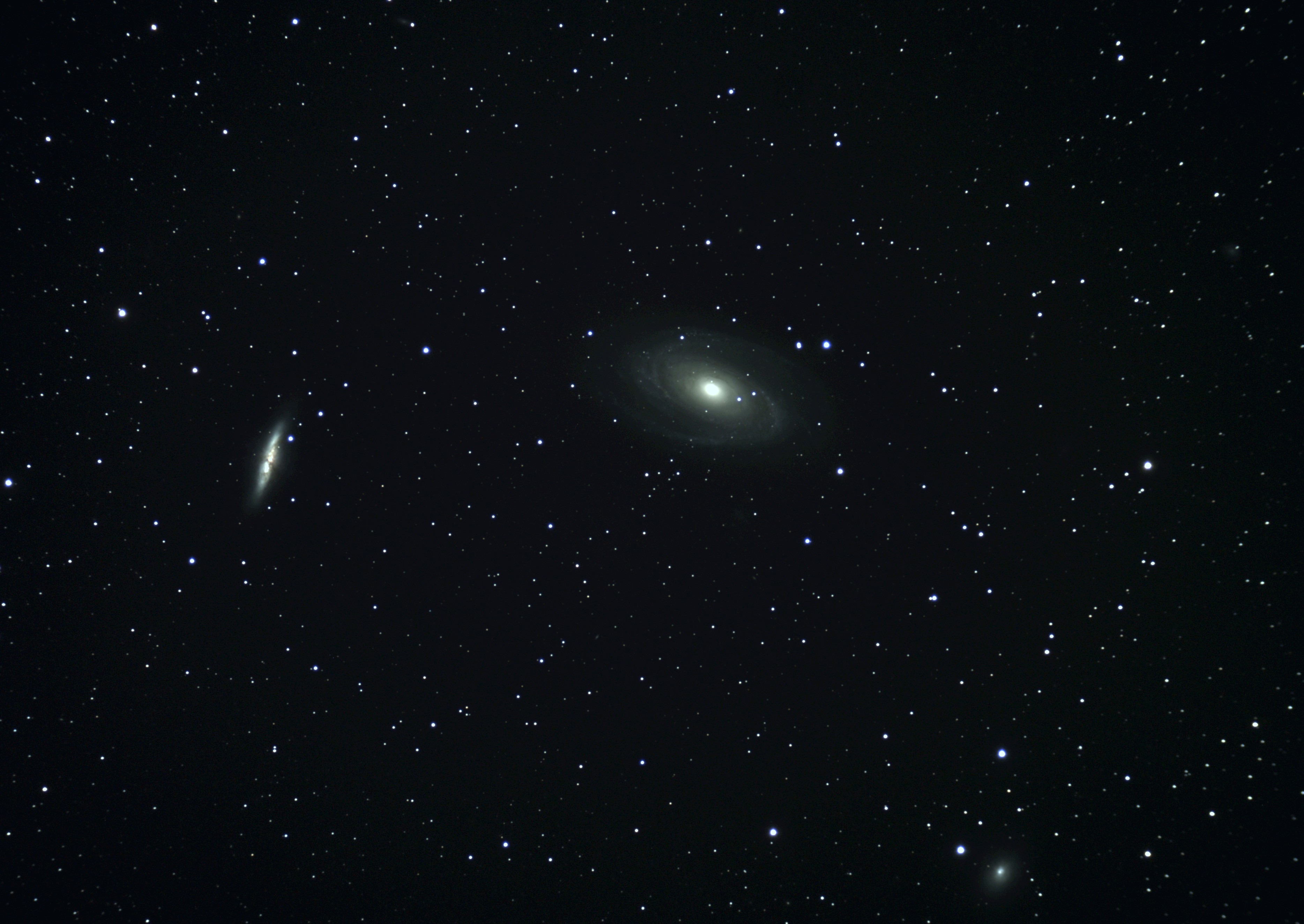
12. Messier 81, Bode's Galaxy with M 82 and NGC 3077
Notes: Bode's is the most distant subject we have attempted and probably the dimmest with apparent magnitude slightly brighter than 7. The galaxy on the left is M 82, an irregular galaxy. The one at the lower right, near the margin, is NGC 3077. According to Wikipedia, "Telescopes with apertures of 8 inches or larger are needed to distinguish structures in the galaxy [Bode's]." Ours is a little over 3 inches, but we can zoom in to see 9 or ten separate parts in M 82 and clear structures in M 81.
Our first attempt was a failure. We were 20 miles north of Phoenix and we had trouble holding a guide star. It may have been the ambient light from the city, or it may have been poor balancing with the counterweight. Whatever the cause, we only managed 3 frames and even those showed tracking problems. But we could see the spiral and the two companion galaxies, so we decided to try again at the first opportunity. We are beginning to realize that imaging requires attention to details.
For this image, we began setting up at 1:00 pm, allowing plenty of time to level the tripod and balance on the right ascension and declination axes. We tried to align the red dot finder in the daylight, but the dot faded out. At dusk we took series of flats, darks for the flats, biases, and a few initial darks. Then we aligned on polaris and lined up our finder scope and red dot finder with the SV80ED. We did a two star alignment and added two calibration stars. With this calibration we could slew and hit the second ring from the center in the PHD Guider bullseye. We did a mechanical polar alignment to the same accuracy. Then, because we don't yet understand the unsync process provided by the CGEM remote, we turned the CGEM off and on, lined up the RA and DEC markers, and redid the 2 star alignment with 2 calibration stars to the same accuracy.
After slewing to Bode's, the scope was east of center, so we balanced the counterweight on the RA axis to make the setup slightly top heavy. The first frames looked sharp in Digital Photo Professional. The spirals of Bode's showed up clearly and the two companion galaxies, M 82 and NGC 3077, were bright. On the third frame the mount tipped over the top producing stars with tails, so we rebalanced on the RA axis to make it slightly bottom heavy. All the subsequent frames looked good. We finished the imaging about 11:30 pm, set the EOS Utility software to take a series of darks, and went to bed.
To process the images, we used Nebulosity's Preprocess in Multiple Sets, Demosaic and Square, and Stack and Align. We were unable to find much detail with Power Stretch and Curves. After thinking about it and browsing on the web we decided to try discarding the flats and biases, using only the darks on the theory that something was wrong with either the flats or the biases. We restacked, stretched the image, and applied curves. The missing detail was recovered. That is the image we posted here. Adding in the biases did not help, and in fact made the color adjustments less effective. When Alan has a chance to work on it in Photoshop, we will replace the image. Meanwhile, we will be trying to determine what went wrong with the flats and biases.
For an update see item 58. Zoom in/out with ⌘↑(+/-) (Mac), ctrl (+/-) (PC).