 |
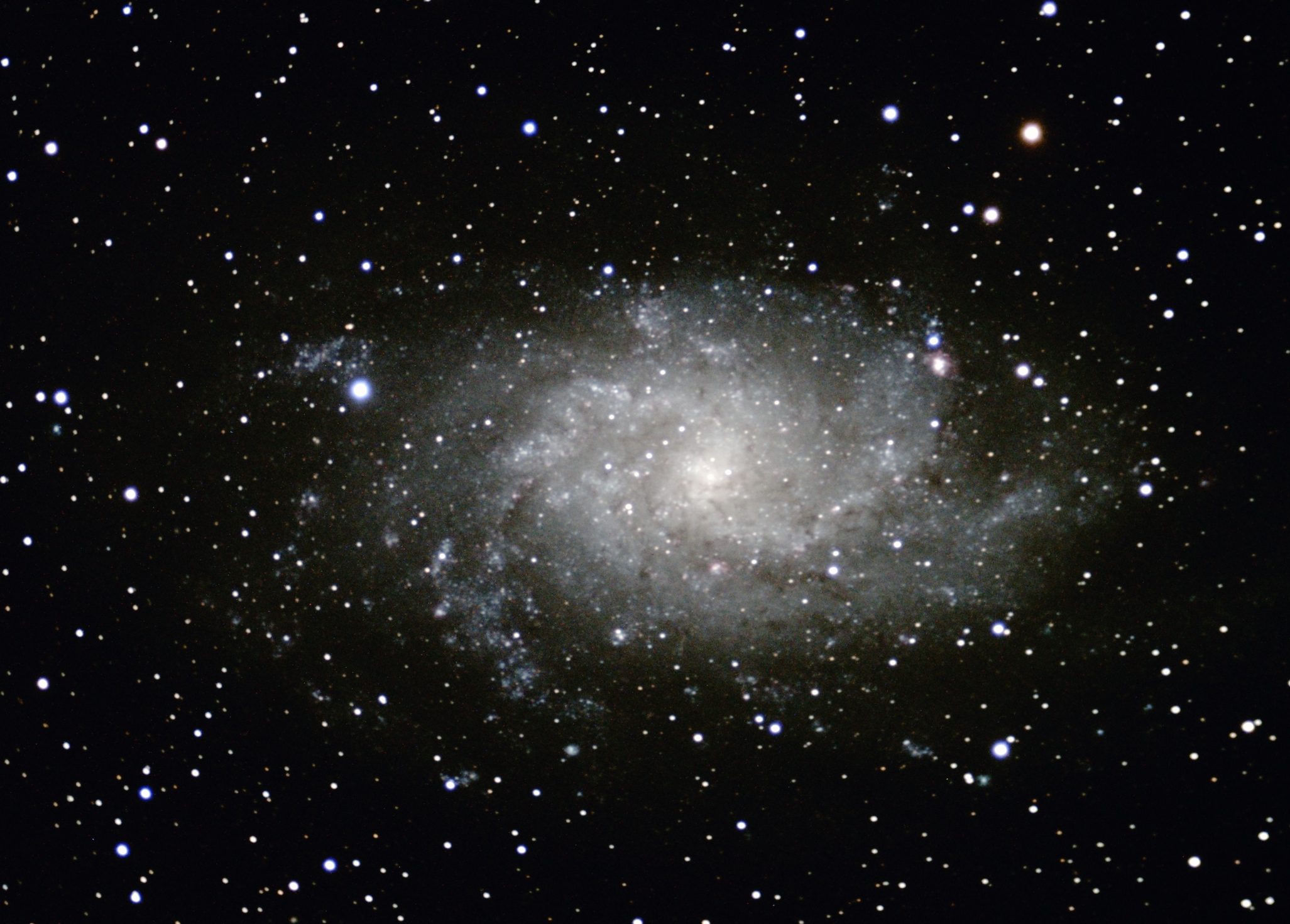
35. Messier 33, Triangulum Galaxy
Notes: East is up; North is right. The bright spot in the northeast corner is the emission nebula NGC 604, which is 1000 times the size of the Orion Nebula (Alan Whitman, 'Digging deep in M33', Sky and Telescope, Dec 2004, 92-95). The spiral arms contain active star formation regions and emission nebulae. Some of the hot spots are easily seen. Click this link for a partially annotated image.
Together with The Milky Way and Andromeda, M33 is one of the three largest galaxies in the Local Group of 46 galaxies. It is classified as type SA(s)cd, meaning it is disk shaped with spiral arms, unbarred, the spiral arms emerge directly from the nucleus or central bar, and the arms are loosely wound. In fact, it may have a bar with a radius of 2.6 Kly, and in our image, we can clearly see what appears to be a bar. M33 has a high rate of star formation, approximately 310 stars per billion years per 1000 square light years, or one new solar mass every two years for the galaxy as a whole. The oldest stars are near or in the core. (All of this information is adapted from Wikipedia, Messier 33, viewed on 11/11/2012.)
Technical Notes: This is our third attempt at imaging M33 (Cf. 2 and 8). The moon was not a problem this time, rising late in a waning crescent stage. We attempted to image on the 9th, but the mouse on the laptop was malfunctioning, causing the mount to run away to the west, so we devoted the rest of that night to darks. On this night, we used the pad on the laptop. We find M33 to be a challenging subject. We stacked 6 hours of 12 minute subexposures, but the image still has a grainy quality. A particularly nice image can be viewed at the site of Patryk Kizny. Zoom in/out with ⌘↑(+/-) (Mac), ctrl (+/-) (PC).