|
|
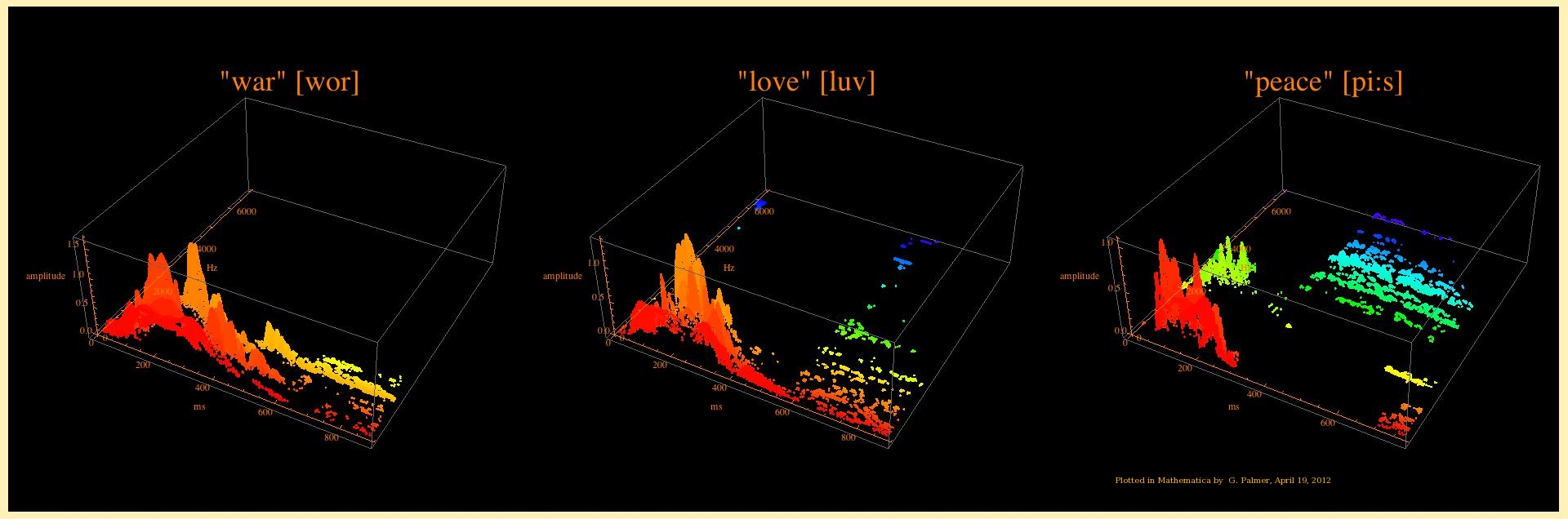
Figure 1. Plots of words war, love, and peace by time, frequency, and amplitude |
MethodsLight and sound have the common feature that higher amplitudes and frequencies carry more energy. Visual light is red and less energetic in the low frequencies, while blue is more energetic in the high frequencies. Sound waves are about a million million orders of magnitude lower in frequency than light waves, and they don't work in the same way, but they have the same relation to energy. Hence, we use visual light as a metaphor whose colors represent the relative acoustic frequencies.The words (mine) were recorded on the iMac using the software program Audacity. Then the .wav file was imported into Mathematica and the words were extracted individually from the data, each word represented as a series of numbers representing pulse control modulations (PCM) read at 44100 samples per second over roughly three seconds. The data for each word was partitioned into moving windows of size 1024 samples with overlap of 1023 samples on successive windows. Each of the 20000 plus windows per word was subjected to a Hamming filter and Fourier analysis. The results were used to make the three plots. The frequencies described on this page can be seen more clearly on the formants page, but the amplitudes appear only on this three dimensional plot. |
ComparisonsThe three words appear to form a series, beginning with war, where we find all of the energy in the lower frequency bands and finishing with peace, where we find much of the energy in the mid frequency bands near the beginning of the word and the high frequency bands in the last half of the word.warHere we see a fundamental tone for the [w] in war [wor] at 200 Hz (red). The [a] appears to add frequencies at 350 to 400 Hz and 400 to 450 Hz (light orange). The [r] appears to add some strong frequencies beginning at 1200 Hz and rising up to 1950 Hz (yellow). There is only a tiny bit of energy over 2000, which occurs at the very end of the word. It appears that the frequencies rise steadily during the utterance of the word.loveThe formants of the first segments---[l] and [u] (low-mid vowel)---of the word love [luv] are very similar to the first two segments of war. The transition to the [v] in love appears to be more sharply defined than the transition to [r] in war, which appears to blend with the [a]. Unlike the evenly rising pattern in war, the frequencies rise abruptly at about 570 ms, so there are bands distributed from 100 Hz (red) through 7000 Hz (blue). There is a strong formant from 2500 to 3050 Hz (light green) and more short-lived frequencies up to 7000 Hz. peaceThere are two new elements in the formants for peace [pi:s]. From zero to 200 milliseconds, there is a wide-band formant at 1900 to 2800 Hz and a narrower band at 3200 to 3400 Hz (light green). The three dimensional plot reveals that the higher band has greater amplitudes. This simultaneous rise in frequency and amplitude is to be expected with the initial [p] and the high vowel [i]. From the abruptly rising frequencies at about 300 ms, we infer that the [s] begins there and lasts for some 400 ms. It takes up the majority of the time in pronouncing the word. This pattern might not hold for a word in the context of a sentence. The [s] appears to have formants at 3400, 4000, 4800, and 5500, 6000, and 7000. Frequencies below 2000, and even below 200, reappear in in the last 150 ms. We note that love is higher than war, and peace is higher than love, so the plots support the common wisdom that love occupies the territory somewhere between war and peace. |
Copyright © Gary B. Palmer
Last modified April 22, 2012