 |
57. IC1396A, The Elephant's Trunk
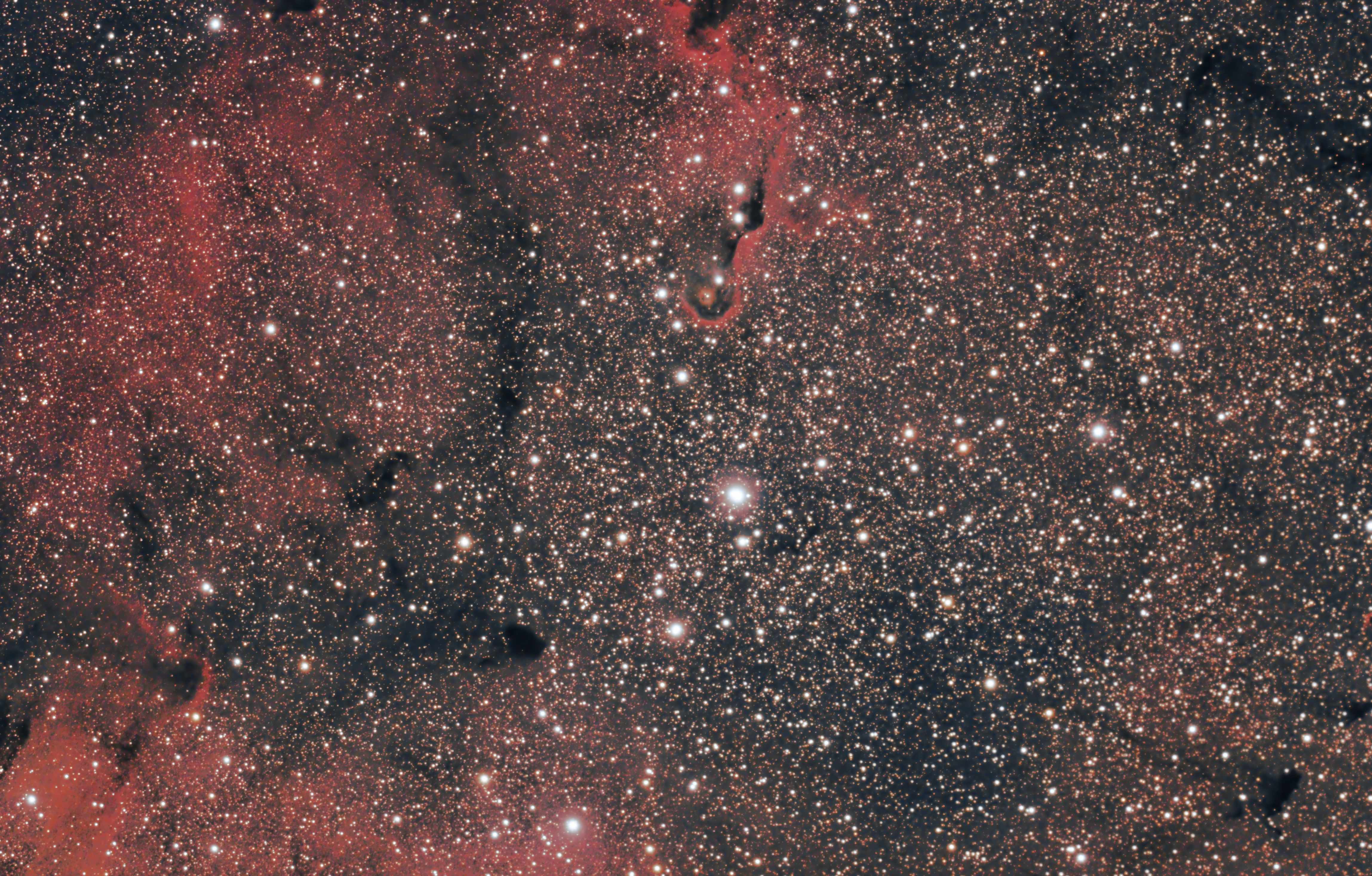
Notes: IC1396A refers to the sinuous emission nebula at the top center of our image. The surrounding field of stars, gases, and dark globules of dust occupies three degrees of sky4, which is much more extensive than our field of view (< 1°) and several times the area of the moon. It looks like a busy star nursery. The distance of 2400 ly is not even two percent of the span of the Galaxy. It lies 58 degrees northward (DEC) within the Milky Way. We don't like to prejudice our understanding of the region or trivialize it by using such popular names as "The Elephant's Trunk", but in this case we can use the elephant image to locate interesting features. We surmise that "trunk" refers to the lower part of the sinuous feature, the part that curves upwards on the right side. As it continues, it appears to outline the front and top of an elephant's head facing left (Figure 1). Along the trunk and outline is where things come together, literally, and where new stars form.
 Figure 1. IC1396 annotated |
Three Lamps at the Center
According to Wikipedia1, the area within the outline consists of a dark patch surrounded by a bright rim of ionized gas, mainly hydrogen, which emits the red Hα light that we boosted for this image. The Wikipedia article suggests that a young (100,000 years) triple star system (HD 206267) accounts for most of the ionization in the region and that of IC1396A in particular, so most of the color that we see has been produced by the triple shining on the vast clouds of hydrogen. The three stars are massive, blue, and very hot compared to most other stars. They are classified as type O.2 The triple appears to be slightly out of round, which is what one would expect from a triple. The rim of IC1396A is being compressed between the triple and two other hot young stars in the center of the dark patch, labeled "core" in Figure 1.
The yellow patches might be leftovers
The center stars are backgrounded by a yellow and pink disk of ionized gas where they have blown out a hole in the dark dust. It looks like the solar wind from the center stars may have blown some of the very light hydrogen gas away from some heavier gas, possibly helium, which floresces yellow. On the other side, the triple has cleared away gas leaving a starry necklace along the rim.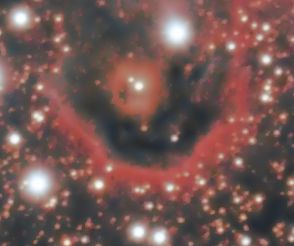 Figure 2. Core stars in IC1396A appear in center. |
Stars come in waves
Star formation in the IC1396 nebula is a subject of study. Barentsen, et al.4 studied clusters of stars forming in front of the rim of region A and two other bright-rimmed, molecular clouds, regions B and E, under the influence of the triplet (Figures 1,3). They found that new stars gather mass more rapidly with increasing distance from the triplet. They theorized that over the past million years star formation in the clusters has been sequentially triggered. To put it in their own words, We discover a spatio-temporal gradient of increasing accretion rates, increasing Spitzer infrared excess, and younger ages away from the ionizing star, providing a strong indication that the formation of these clusters has been sequentially triggered by HD 206267 [the triplet] during the last ~1 Myr.
How does this work? It seems counter intuitive that the stars most distant from the ionizing star would form most rapidly, but it must be the case that star formation first takes place closest to the ionizing star(s). The infant stars accrete rapidly at first. As they take up infalling hydrogen and clear the space around them, accretion slows down. Space clears allowing starshine from the triplet to penetrate further out in the cloud. The more distant regions achieve sufficient compression to form their own hot, hungry stars and accrete hydrogen fast enough to burn more brightly than the older stars. As the older stars mature, they grow brighter even in the absence of accretion, but they cannot match the stars that are actively consuming infalling gases.
That said, I must warn you that this story is entirely hypothetical and the author of it has no training whatsoever in astrophysics. I now think that story is probably wrong. After watching Filippenko's DVD on the formation of Galaxies, I think what is probably happening in the neighborhood of IC1396A is that each wave of new stars radiates strongly. The only place where there is material left for compression is on the side away from the triplet. Outward radiation from the new generation of stars contributes to an expanding wave of star formation. Inward radiation encounters only the first generation of stars and the triplet.
Reading Barentsen's Map
Figure 3 requires some study. Size of the star icons (circles and triangles) refers only to age, not to rate of accretion. Larger is newer, so there is probably some correlation with rate of accretion. Circles refer to rates of accretion where the log of the accretion rate, M′, is greater than -8.5. That should mean that the rate of accretion is greater than 1/500 M⊙ (solar masses) per year. In other words, a red circle shows a star that is gobbling more than the equivalent of the Sun in hydrogen gas porridge every 500 years. Large red circles are new and bright. Small black triangles are old and dim. The large red circles should be found farther from the triplet. Now take one more look at the frontispiece.
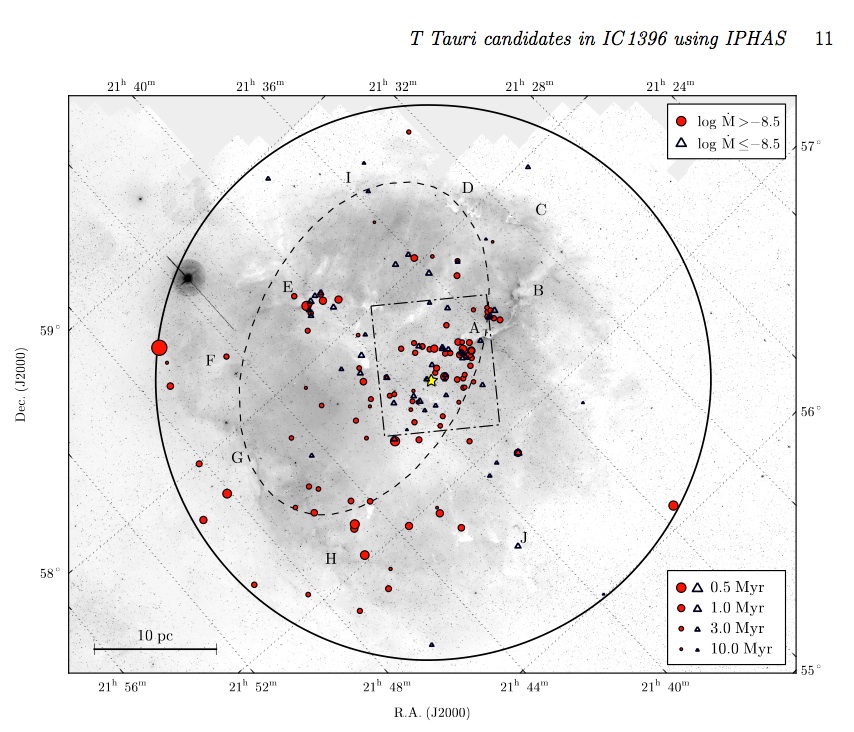
Figure 3. Map of star formation candidates (Barentsen, et al., n.d.)
References
1. Wikipedia, Elephant’s Trunk Nebula, viewed on August 3, 2014.
2. Wikipedia, HD 206267, viewed on August 3, 2014.
3. Kepple, G. R. & G. W. Sanner, The Night Sky Observers Guide, Vol. 1 Richmond: Willman-Bell, Inc. 1998, p. 138.
4. Barentsen, Geert, et al., T Tauri candidates and accretion rates using IPHAS: method and application to IC1396, http://arxiv.org/pdf/1103.1646v1.pdf, viewed August 3, 2014.
Zoom in/out with ⌘↑(+/-) (Mac), ctrl (+/-) (PC).