 |
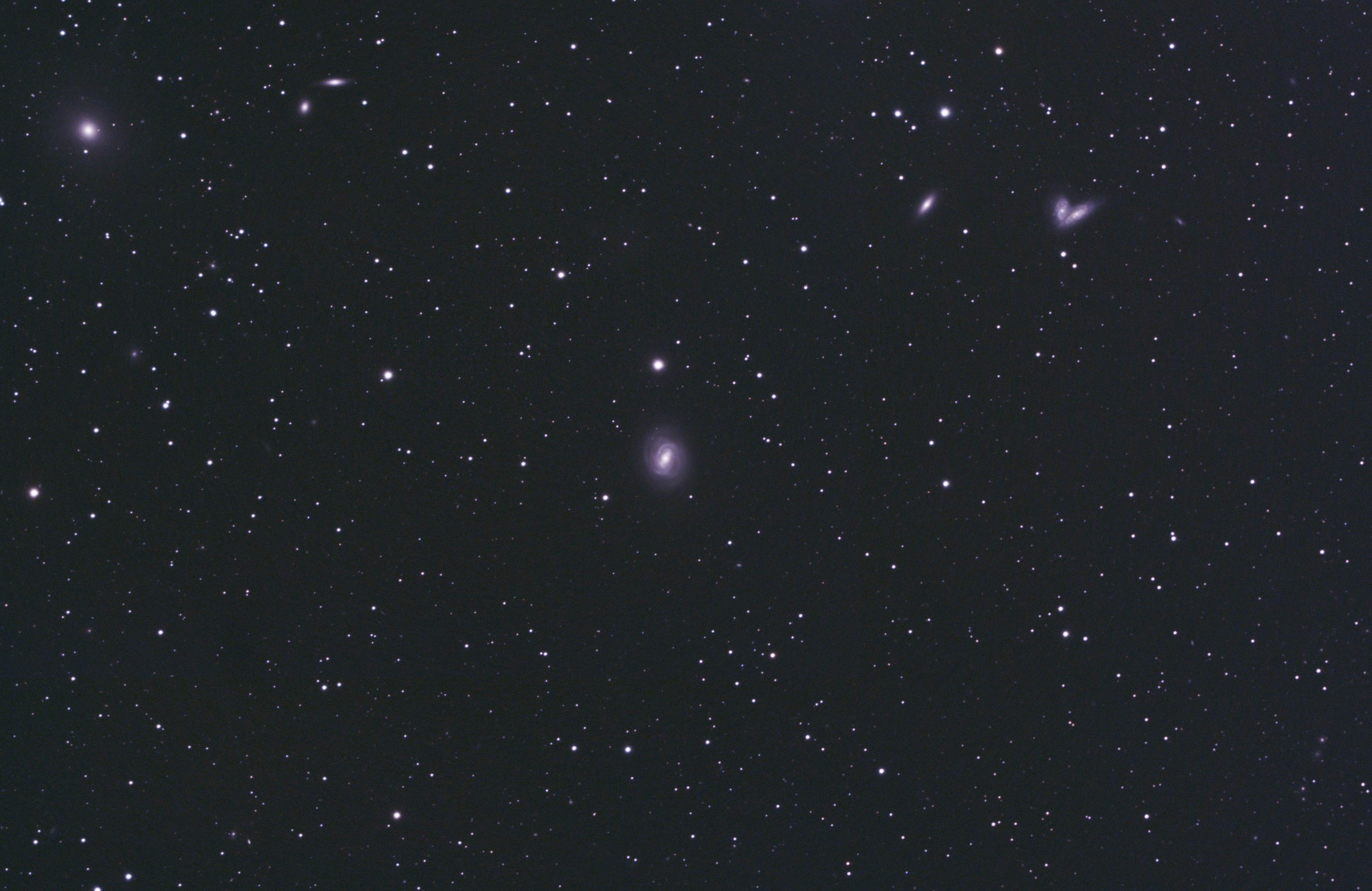
56. M58, spiral galaxy in Virgo Cluster
Notes: In this image we can see at least nine galaxies of the Virgo Cluster. M58 is the relatively large spiral galaxy in the center. The two partially superimposed galaxies on the upper right appear to be spirals. They may be close enough together to influence one another. The bright one on the upper left appears to be an elliptical galaxy. The others are indeterminant. We will post information on the identities of all the known galaxies in this image as soon as possible.
M58 is said to be the brightest galaxy in the Virgo Cluster, but it is approximately 32 times dimmer in our view than M101. The galaxies were imaged through gauzy high cirrus clouds. Nevertheless, we can see that M58 is a barred spiral. According to Wikipedia1, M58 is one of the very few galaxies known to possess a UCNR (Ultra-Compact Nuclear Ring), a series of star-forming regions located in a very small ring around the center of the galaxy. Our image lacks the resolution to confirm that.
Footnote
1. http://en.wikipedia.org/wiki/Messier_58, viewed on May 3, 2014. Zoom in/out with ⌘↑(+/-) (Mac), ctrl (+/-) (PC).