 |
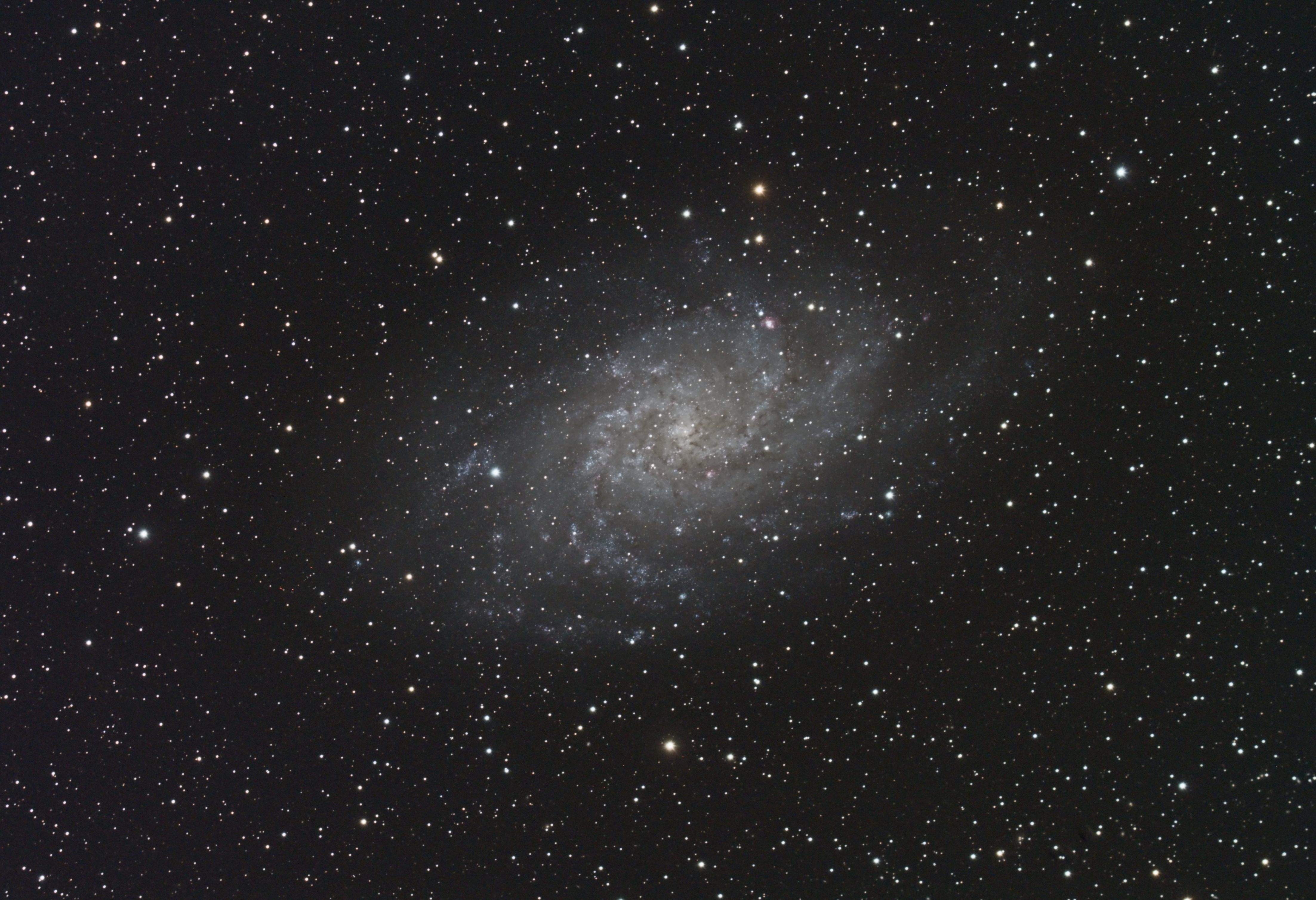
55. M33, Triangulum Galaxy
Notes: If one is willing to sort through the argot of professional astronomers, Van Den Bergh's Galaxies of the Local Group1 will provide more information about M33 than most people would ever want to know. Here we just mention a few of the interesting bits.
At its center, M33 has a binary star system. The primary star is a black hole of about 10 solar masses. The binary emits soft (relatively low energy) x-rays on a period of about 108 days. More diffuse x-rays are also emitted by various sources in the disk, including "accreting systems" and "young super nova remnants". Van Den Bergh cites evidence that the nucleus consists of young, metal-rich stars. The gas in the nucleus has an unusually high ratio of nitrogen to hydrogen.
The galaxy has an envelope of neutral hydrogen gas (HI) that is tilted by about 30° with respect to the inner disk. The combined mass of the disk and envelope together amounts to 55 billion solar masses.1 See Table 1 for comparisons.2
Table 1. Masses of Three Largest Galaxies in Local Group
| Name | Mass x 109M☉ | |
| Triangulum (M33) | 55 | |
| Milky Way | 1000 to 1500 | |
| Andromeda (M31) | 1000 |
The outermost part of the disk of M33 has been "strongly warped," but there is no companion galaxy available to blame it on. The spiral structure is "open, and not very well developed." There are two main spiral arms, which match best to HII regions. They match less well to dust clouds, loose star clouds, and OB (hot star) associations. It is expected that in the future, the areas of greatest star formation will move from the nuclear region out into HI regions in the disk. The rate of star formation in the central 3.9 kpc2 for stars greater than .1 solar mass is roughly one star per 23 years. At this rate, the gas available for star formation in the central region will be exhausted in 1.7 billion years. A similar process is occurring in the Milky Way galaxy near the Sun.
The bright reddish lump visible at the end of the central and upper spiral arm is NGC604, an Hα emission nebula. It is the largest H II region in M33, about 40 times the size of Orion and 6300 times as luminous.3 The emissions are produced by a central cluster of 200 stars shining on H II gas.
1. Van Den Bergh, Sydney. (2000). The triangulum Galaxy (M33). Galaxies of the Local Group. Cambridge University Press, 72-91.
2. Wikipedia, Andromeda_Galaxy, viewed on January 13, 2014.
3. Wikipedia, Triangulum_Galaxy, viewed on January 13, 2014.
Zoom in/out with ⌘↑(+/-) (Mac), ctrl (+/-) (PC).