 |
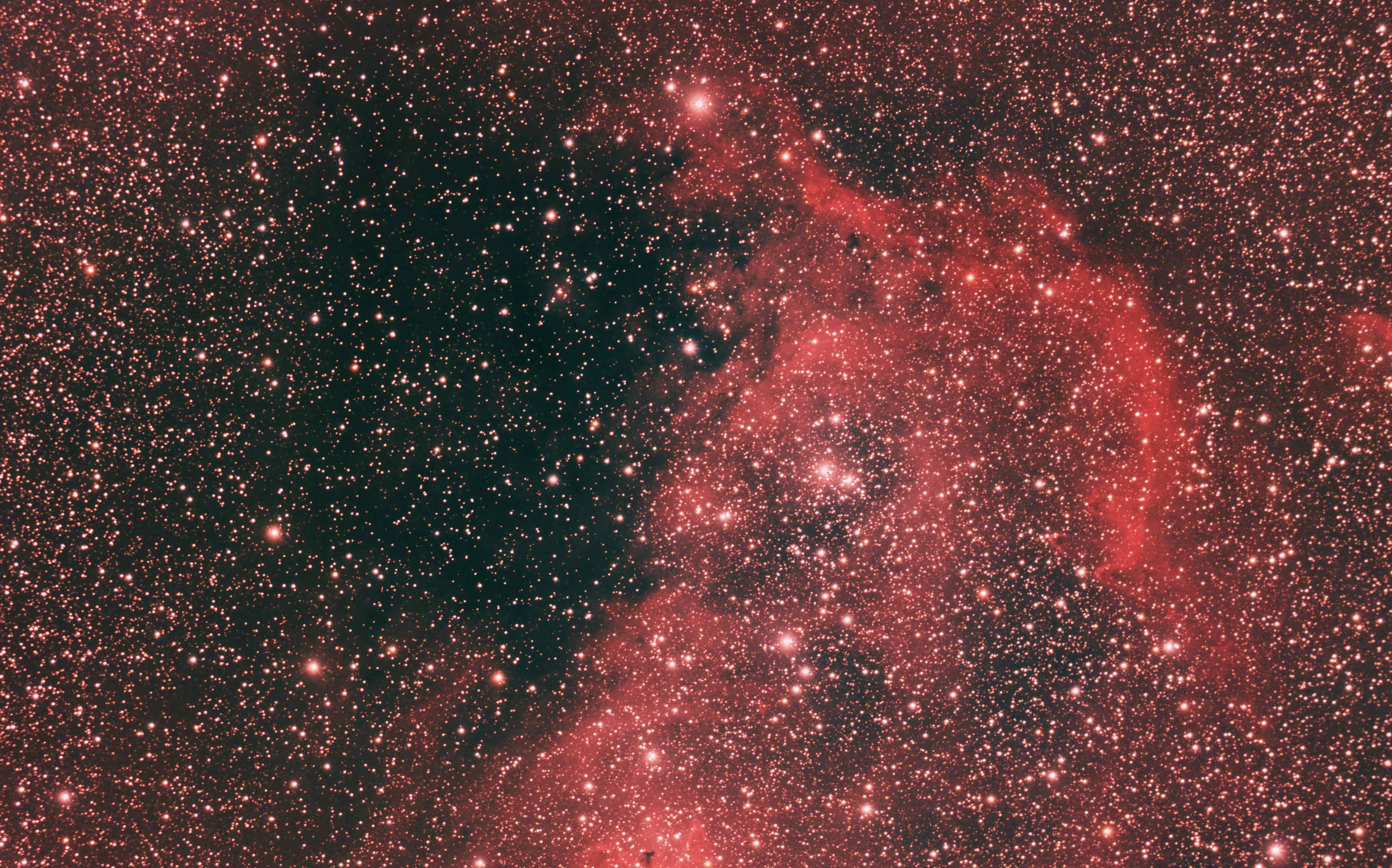
54. IC1848, Soul Nebula
Notes: We found the Soul Nebula to be a difficult subject. It is so faint that it doesn't show up at all on the screen display of the stack .FITS file. The Wikipedia page does not show an apparent magnitude. The Deep Sky Objects page lists apparent magnitude of 6.5, but this figure is suspect for two reasons (1) We normally have no trouble imaging objects of magnitude 6.5. The Swan Nebula (number 51) for example has apparent magnitude of 6.0. The Trifid Nebula (number 48) has apparent magnitude of 6.3. (2) the Wikipedia page for IC1805, the Heart Nebula, which is sometimes imaged together with the Soul Nebula, gives the Heart Nebula an apparent magnitude of 18.3.2 The two nebulae appear to have similar brightness.
This image shows only about half of the nebula. If we image this subject again we will turn the camera to a position that accommodates the shape.
We have been following the process of accumulating preprocessed frames from several imaging sessions. When we think we have enough exposures for a good image, we stack them all. If the telescope has been taken down and realigned in between sessions, aligning and combining can become difficult and tedious. We have often wondered if we could create a stack for each night and later combine the stacks in a master stack. The number of sessions involved in IC1848 forced us to try it. We see no obvious difference in quality. The process is much easier.
We were having difficulty with elongation of stars, which became particularly noticeable as the subject approached the meridian. This caused us to reflect that the CGEM mount displays play or slack when the last adjustment during alignment has used the bottom button of the hand control or NexRemote virtual control. The bottom button directs the scope rightwards on the DEC axis. We take up the slack by using the top button, which slews the lens leftward on the DEC axis—west if the scope is pointed north. We should be able to force the mount to do this automatically during tracking by adding a small rightward (eastward) error to the polar alignment. Suppose a mount pointing at the celestial pole has a small eastward error in alignment. The error shifts the RA path of the scope rightwards of the path of the deep sky subject (See diagram, number 28, which illustrates the error). The error can be corrected by leftward movement on the DEC axis. That is what we want to happen while guiding. If we slew to a subject and guide, the subject will appear to climb relative to a grid on the screen. The guiding software will compensate by directing a leftward movement on the DEC axis (and the RA axis), thereby taking up slack in the worm gear.
References
1. Deep Sky Objects Browser, viewed on November 3, 2013.
2. IC1805, the Heart Nebula, Wikipedia, viewed on November 3, 2013. Zoom in/out with ⌘↑(+/-) (Mac), ctrl (+/-) (PC).