 |
53. M31, Andromeda Galaxy (Ανδρομεδη)
Notes: If you had the great misfortune to read this page prior to November 28, 2013, you would have found that we made an opposite claim to what is asserted now. How did this exasperating mistake come about? To encounter a littany of what are deemed to be the most important facts about Andromeda, read almost anything on the topic. We learn that the galaxy is a very massive, giant spiral galaxy in the same league as the Milky Way; it is moving towards the Milky Way and will some day merge with it; it has a disk that has been warped by ancient encounters with one or more of its satellite galaxies; it has many variable stars and star associations; it belongs to a group of galaxies known as The Local Group.
What else could one want to know? How about which side is the near side and which the far? Is the near side the one with the dark dust lanes? What is the direction and angle of tilt? Is it tilted away from us (top farther away) or toward us (top closer)? It must be one or the other, because spiral galaxies tend to be circular. Since Andromeda looks elliptical, it must be tilted on the long axis. What direction is it rotating? Clockwise or counter-clockwise? These seemed very basic things to know and simple to figure out, but it wasn't quite that easy. I couldn't find them readily by browsing the internet, and I have yet to find them stated clearly in print. We must somehow deduce them from the hundreds of images strewn across the internet by amateur astronomers and professionals who mainly concern themselves with aesthetics (the amateurs and near professionals) or with advanced scientific problems. The professionals seem to know these basic things so well that they can't imagine that an amateur would find them puzzling, so they don't write about them, even in introductory textbooks.
I tried to reason out tilt and rotation from the images, but the initial results were poor. We work with the brain cells we are given. I posed the questions of Andromeda's tilt and rotation to a group of savvy amateurs and found that none of them knew the answers. I took the questions to a professional and got a partial answer regarding the direction of rotation and the orientation shown on star charts, but I was still left wondering how to apply it to the image at the top of this page, which is not in the star-chart orientation. I woke up at 6:00 am on the third day of taking up this challenge with two insights which I think enable the correct deduction. You may judge. The insights are: (1) Because Andromeda is so distant, however much we change our viewing position here on Earth, the angle of inclination between Andromeda and our line of sight remains essentially the same for our purposes; (2) Whatever position we choose to view Andromeda, so long as we remain on Earth, it will always appear to be rotating in the same direction. The insights were correct, but I followed them to the wrong answers. The right answers are that Andromeda is inclined 77° towards us and it rotates in a counter-clockwise direction when viewed from Earth or from anywhere in the Milky Way Galaxy. Though that much is clear, it can still be difficult to interpret the orientation of images taken from different perspectives or rearranged in processing.
Which side is up?
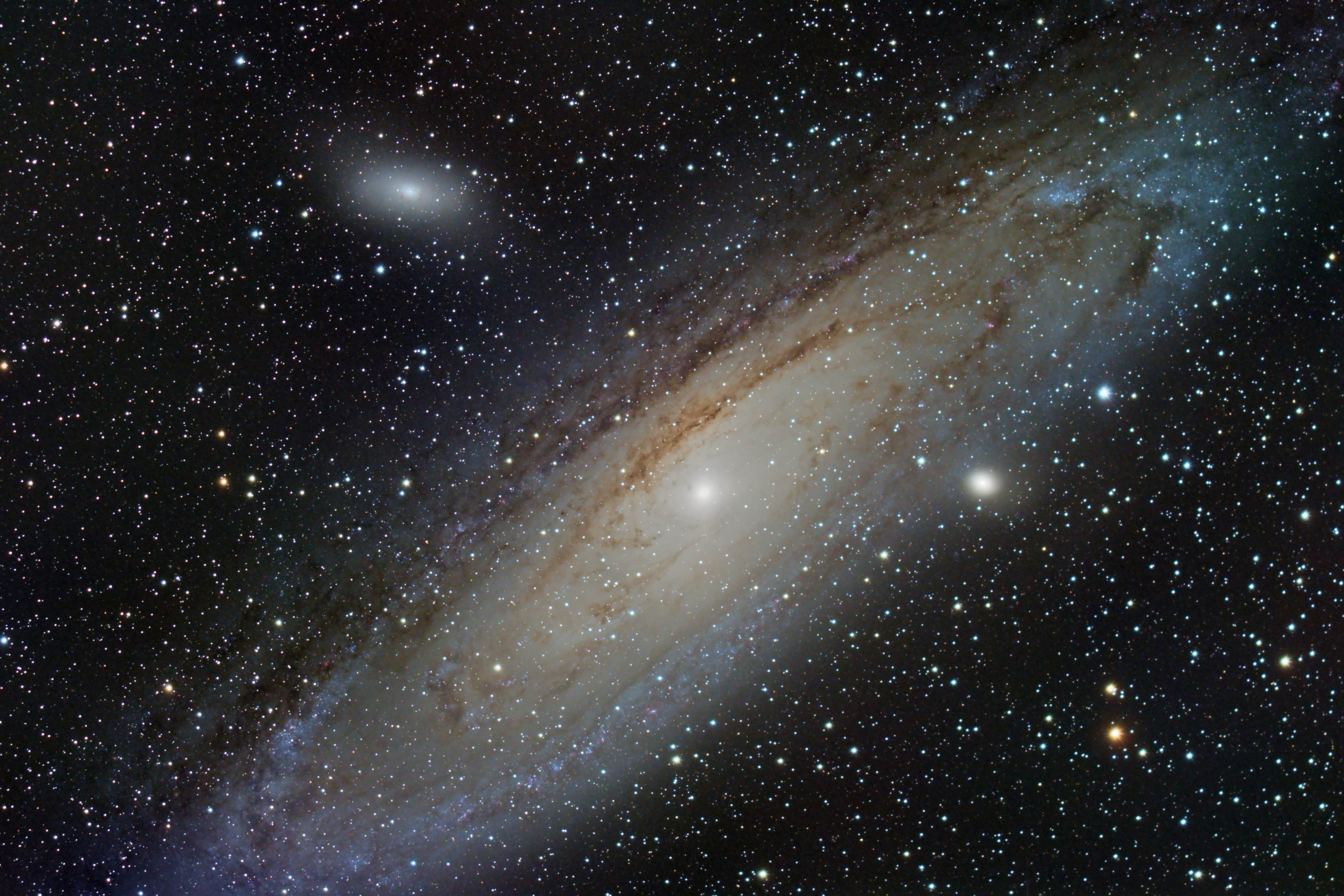
The above image of Andromeda always make us think of the top of a flat or concave saucer that is tilted up in back and down in front. Others see the same image as tilted the other way—up in front and down in back. Then it seems to be concave, a bowl opening downwards. This second view seems reinforced by the greater detail around the heavy lines of dust. Which is the correct gestalt? Wikipedia1 says The galaxy is inclined an estimated 77° relative to the Earth (where an angle of 90° would be viewed directly from the side). They don't explain exactly what they mean by "inclined", but they seem to follow Hodge9, who uses inclination to mean the angle between the plane of the galaxy and the plane of the sky. He contrasts it with tilt, which is the angle between the plane of the galaxy and the line of sight. But the term incline is still problematic. The online Oxford English Dictionary has it leaning away. The online Merriam-Webster defines it as to bend forward, but also defines it more generally as having a slope or making an angle with a line or plane. Which is it? Forward or back, towards or away from a viewer on Earth? Unfortunately, using what I knew about Andromeda, I could make an argument for either point of view. I guessed that it means to lean towards the viewer.
A diagram such as Figure 1 may help. We first imagine the plane of the galaxy to be drawn perpendicular to the line of sight. We incline the plane 77° by tipping the top either or away from Earth. The tip towards Earth leaves the near edge tilted up from the line of sight by 13°. The tip away leaves the far edge tilted up by 13°. The tip towards would locate the prominent dust clouds on the top edge and the near side, producing the gestalt of an upside down bowl. The tip away causes one to see a generally flat surface with a bit of a bulge in the center. The dark dust clouds are now on the far side. Minor axis refers to the line across the narrowest part of an ellipse.
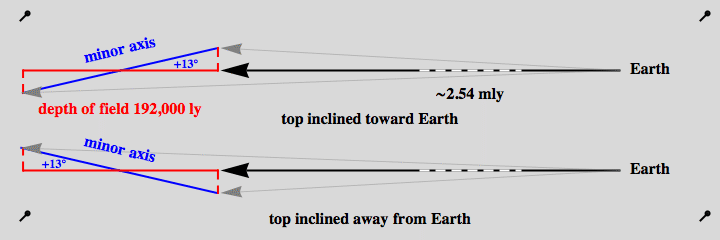
Figure 1. Viewing arrangement and alternative inclinations, Andromeda seen from Earth
A fellow amateur astronomer, Tony Finnerty, theorized that the near edge of Andromeda is just enough closer than the far edge to give us some perspective. The apparent width or visible span of Andromeda along the minor axis is 1 degree or 40,000 ly, which is 1.75 percent of the distance from Earth to Andromeda. Taking the angle of inclination into account, the near edge is 192,000 ly nearer than the far edge. The difference is 7.6 percent of the distance from Earth to Andromeda. The edge where the dust lanes are least obscured by clouds of stars and therefore appear clearly should be the near edge. Finnerty's approach leads to the conclusion that our image of Andromeda should be viewed as an upside down bowl.
The Wikipedia image appears to be rotated 90 degrees counter clockwise compared to ours. How does that happen? Our image, taken with a refractor, is what one would see if one could see Andromeda with the naked eye at high magnification. Was the Wiki Andromeda taken with a reflecting telescope? Or could it be that the image was taken with the camera located north of 42° latitude and pointing south? Ours was taken from 39° latitude when Andromeda was east of the meridian. The mere 3 degrees of difference between our latitude and the declination of Andromeda means that the galaxy rises very near due east and six hours later passes nearly overhead putting north on the left and east on the far side of our image, but was the far side the top or the bottom?. Was the Wikipedia image taken west of the meridian? Or did the image get flipped in processing? The author doesn't say.
Which direction is Andromeda spinning?
My eye sees trailing spiral arms that appear to show the galaxy spiraling outward in a clockwise direction indicating that the rotation is counter-clockwise. To determine whether this impression is correct, we will need some facts. The major axes of Andromeda are referred to in Hodge as northeast and southwest. Hodge was apparently referring to the apparent major axes viewed along the line of sight depicted in star charts of the northern hemisphere. He cited a famous study by Rubin and Ford (1970) of emission objects in Andromeda11,12. Rubin and Ford found positive rotational velocities (going away) along the northeast major axis and negative rotational velocities (approaching) along the southwest major axis (Figure 2). This information can help us determine the inclination.

Figure 2. Plot of rotational velocities by distance from center of Andromeda (Hodge 1992, p. 91).
In the orientation normally shown on star charts, east is left and west is right. Thanks to Dr. David Galadí-Enriquez of the Centro Astronomico Hispano Aleman (Calar Alto) for pointing this out in personal communication (November 7, 2013). North is up and south is down. The orientation seems to assume a viewer looking at the sky while lying on the meridian with head toward Polaris and feet toward the equator. The amazing images (the last two on the page) produced by the Calar Alto Observatory clearly show positive (counter clockwise) rotation from the star-chart orientation. The orientation and direction of rotation are the same as that shown in the figure on the right below. Hodge (p. 317) presented two plots of open clusters showing Andromeda spiraling in opposite directions (Figure 3). He favored the two-armed trailing model on the right. Galadí-Enriquez added there is no hint of counter-rotation in Andromeda disc or central bulge, i.e., radial velocity studies show that Andromeda rotates in the same direction all along from the nucleus to the outskirts of the disk. It does not rotate at the same speed, but it does rotate in the same direction throughout. Furthermore, the rotation is seen as counter-clockwise from any point this side of Andromeda, and therefore from any point on Earth.
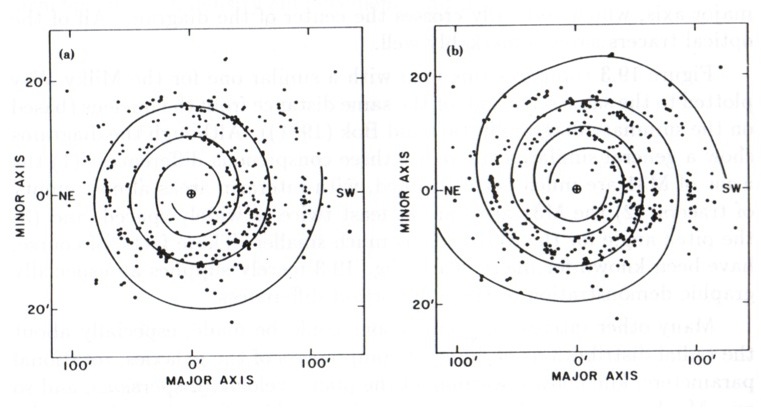
Figure 3. Two theories of orientation of spiral arms based on open clusters (Hodge 1992, p. 317).
The rotational velocities vary greatly across the radius. Hodge (p. 106) identified three components (Figure 4). The nucleus rotates with a maximum velocity of about 150 km/sec at 11.4 light years (3.5 parsecs) from the center. Note that the radius is on the order of magnitude of 100,000 light years. Outside the nucleus, there is a central disk with a higher maximum rotational velocity of 225 km/sec at 1304 light years (400 pc) from the center. The third component reaches a maximum velocity of about 280 km/sec at 32,600 light years (10 kpc) from the center.
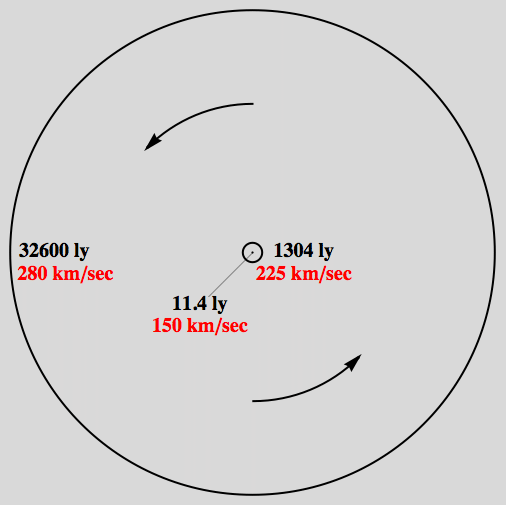
Figure 4. Maxima on rotational velocity curve by distance from center
What are the implications for understanding the inclination of Andromeda? Here we need another diagram showing the star-chart orientation and the basic facts of direction of rotation and rotational velocity (Figure 5). Declination and right ascension are shown on the margins and the relative positions of M110 and M32 are indicated.

Figure 5. Andromeda in Star-Chart Orientation
Since the rotation of the galaxy is counter-clockwise moving (in Figure 5) from the top leftward and downward in the direction of M32, and since the northeast end on the upper left is moving away from the viewer, then the side on which we see M32 should be the far side. In the image at the top of this page, we should see Andromeda as a warped disk with the far side to the lower right. The dark lanes of dust are on the near side, just as Finnerty theorized. This also shows that Andromeda leans (inclines) toward us along the minor axis with the northwest edge (top left in our image) being closer. Our image is rotated 90° counter-clockwise from the star-chart orientation.
This view of things seems to resolve all the facts:
(1) The angle of inclination between Andromeda and a plane perpendicular to our line of sight is 77°;
(2) because Andromeda is so distant, however much we change our viewing position here on Earth, the angle of inclination remains almost constant;
(3) the northeast end of Andromeda has positive rotational velocity;
(4) images by Dr. Galadí-Enriquez show counter-clockwise (positive) rotation;
(5) the apparent direction of Andromeda's rotation does not depend on one's position on Earth; it is always counter-clockwise.
Andromeda as a ceiling fan.
For a concrete model, try turning on an overhead fan. First stand south of the fan and set the fan so that it turns in a counter-clockwise rotation as you look up at it. Then move around to the north side. It should still appear to be rotating counter-clockwise. If you are on the south, the blades on the right (east) side will be moving toward you. If you are on the north, the eastern blades will be moving away from you (positive radial velocity). This helps with the visualization of a spinning disk, but it doesn't take into account the inclination relative to the line of sight. Inclination is crucial in determining whether rotational velocities are positive (away from viewer) or negative (towards viewer). Viewer's location on earth is insignificant.
How big is Andromeda?
Simple trigonometry based on the observed visual span of one degree across the minor axis and the inclination of 77 degrees towards us from vertical would put the diameter of Andromeda around 200,000 ly. But like our Galaxy, Andromeda has a halo, a cloud of stars that follow individual orbits that are not coordinated with those of other stars. This halo may be five times larger in diameter than the disk, extending toward Earth as far as 500,000 ly.9 Thus, Andromeda may extend from its center out to 20 percent of the distance to the Earth.
It's headed our way.
When you realize that Andromeda is approaching earth at 109 km/s (± 4.4 km/s)17, it might seem uncomfortably close, but 109 km/s is only 1/2752 the speed of light. If it takes 2.51 million years for a ray of light to reach us from Andromeda, as it would now, it will take 6.9 billion years for Andromeda itself to show up. It would take about 600 million years for Andromeda just to escape its own shadow. Furthermore, when it does arrive along with the Triangulum Galaxy (M33), it is not expected to have any noticeable effect on our solar system, because the density of stars and other matter is so low in all three galaxies that collisions will be rare, not that anyone will be around to notice.
Where is the warp?
The shape of Andromeda is another source of puzzlement. Wikipedia1 says
Analysis of the cross-sectional shape of the galaxy appears to demonstrate a pronounced, S-shaped warp, rather than just a flat disk.... A possible cause of such a warp could be gravitational interaction with the satellite galaxies near M31. The galaxy M33 [Triangulum] could be responsible for some warp in M31's arms, though more precise distances and radial velocities are required.
Unfortunately, the S-shaped warp is not traced out in the Wikipedia entry. The gestalt of the S depends upon one's gestalt of the orientation of the galaxy itself. We can get some idea of the warp from images posted by Guhathakurta, Choi, and Reitzel. The news release from 2001 says the warp is especially pronounced on the northeast (left) side of the major axis.7 What they are referring to as the northeast (left) is the near side to the center left of our image, the side that appears to be pulled out.
The tour.
Looking at Andromeda, we always feel like a tourist who has only a week to see a whole country. Even if we had a means of going there, Andromeda is so large that we could never visit all the interesting features. One such feature appears on the upper right of this image (Figure 6). Find the two large, dark dust clouds that look like neighboring lakes. Just to the left of the inner cloud there is a patch of bright blue known as NGC 206, which is rated by a Wikipedia entry as one of the largest and brightest star formation regions of the Local Group.3 The cloud contains over 300 stars brighter than magnitude -3.6. These are young, very hot, fast-burning stars, which are expected to burn out completely within only 10 million years. In the galactic time frame, that is like Christmas lights winking on and off. NGC 206 probably also contains hundreds or thousands of less massive stars. One of its two subregions contains Cepheid variable stars. NGC206 is about 3,260 ly in diameter.
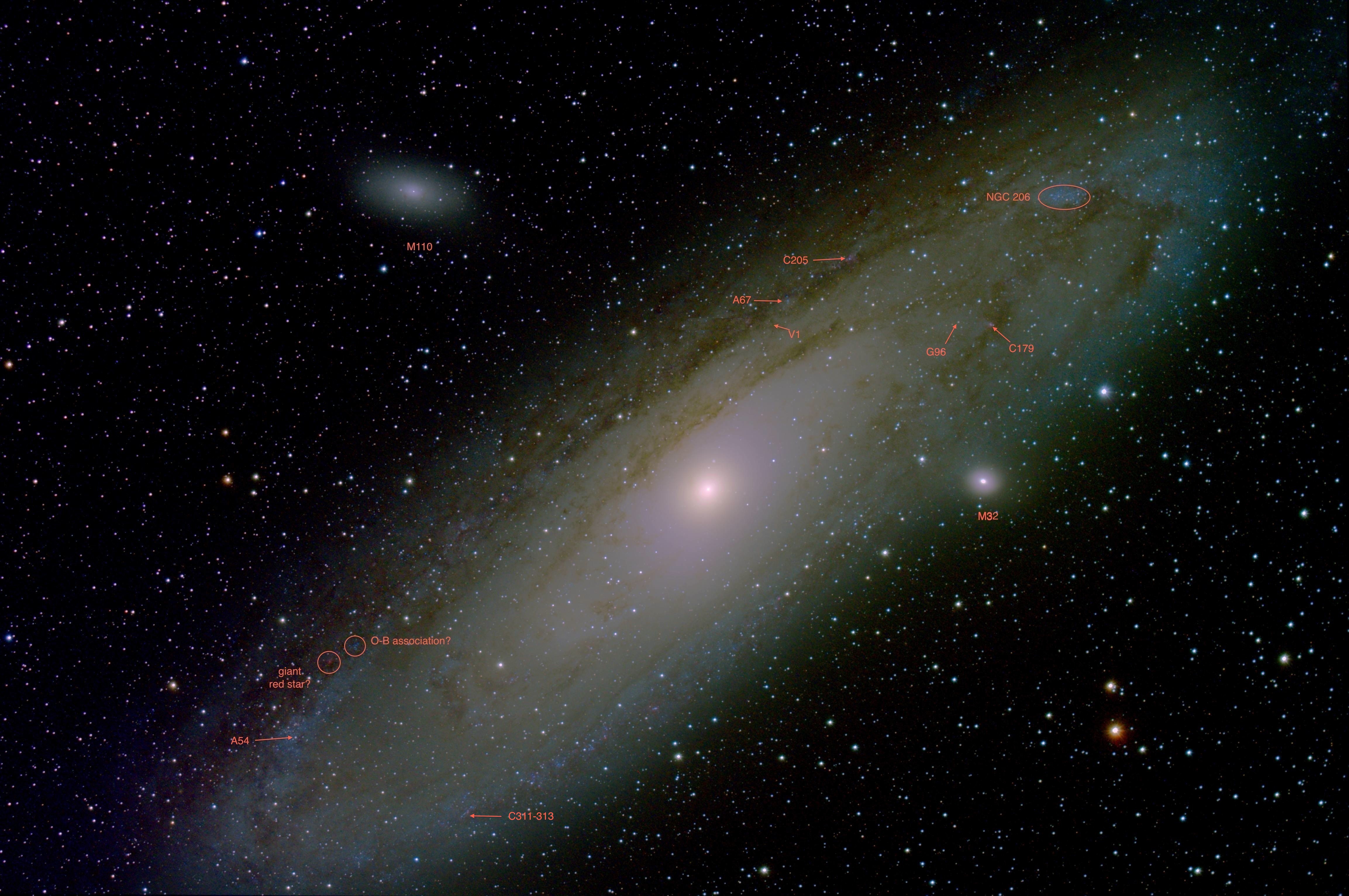
Figure 6. Andromeda with annotations: A, star association; C, cluster; G, globular cluster; M, Messier; NGC, New General Catalog; V, variable.
Click to expand image in new page
Because the cloud NGC 206 contains stars of spectral types O and B, it is referred to as an O-B association. Stars of type O, such as those in Orion's Belt, burn hotter than 30,000 K. Their temperatures are the highest on a scale which starts with type M at less than 3,500 K. Type B stars, such as Rigel, are the second hottest at 10,000 K to 30,000 K. Type O stars have lines of ionized helium and weak hydrogen lines. Their brightest wavelengths are ultraviolet at less than 97 nanometers. Type B stars have lines of neutral helium and "moderate" hydrogen lines. Their brightest wavelengths are ultraviolet from 97 to 290 nm.4 Cool Cosmos at Caltech has posted an ultraviolet image of M31. It can be found about halfway down the page. NGC 206 is not clearly distinguished there. Wikipedia has more on O-B associations.
The V1 Cepheid pulsating star found by Hubble in 1923 was the first variable ever observed outside our own Galaxy. It appears in this image, but it is very dim. To find it, start at the core and go in the direction of one o'clock. Cross the first lane of dust and continue towards the second. Before you arrive at the second, you should see about a dozen stars arranged like a small flock of geese with the wings curving outwards. The lead star points to a dim triangle of stars located next to a black cloud of dust. The lower right star on the triangle is V1. It helps to zoom in using the view menu or control-plus or command-plus keys, or just see the cutout in Figure 7. Over the course of a month (31.4 days to be more precise), V1 varies in brightness from magnitude 18 to magnitude 19.4.5

Figure 7. Cutout showing V1 cepheid
For a pointer and blow up of V1, see the Hubble image and the image taken in a different orientation by Ed Johnson.
For another interesting object, proceed from the core in the direction of 12:44 o'clock. Again, cross the first dust lane and continue a short distance (5 or 10 light years) until you arrive at two pairs of stars. Just above the lower pair, there is a dark spot of dust. Were we looking at a spot like this in our own sky within the Galaxy, it would probably appear as a very large dark nebula.
There is a bright red object located just outside the bright blue band in the lower left quadrant. We don't know what it is yet, but it appears in other images of Andromeda such as the NASA Hubble image linked above. We are guessing it is a giant red star. There appears to be a very blue reflection nebula or string of stars just above it and to the right. Perhaps this is another O-B association. There appear to be more of the red or reddish stars and more strings of stars on the side facing companion galaxy M110 (upper left) than on the side facing M32. The Wikipedia article on Andromeda states that M110 also appears to be interacting with M31, and astronomers have found in the halo of M31 a stream of metal-rich stars that appear to have been stripped from these satellite galaxies.1 Unfortunately, the article does not tell us where in the halo to look for the stream.
Our images of Andromeda show more blue in the upper right (NE) and more red or magenta in the lower left (SW). The counter clockwise rotation would mean that the right end of the galaxy is rotating towards us and the left end is rotating away from us. If the speed of rotation were sufficient to register a redshift on our camera chip, that would explain the color differences. But we can calculate that the rotational velocity can only explain about one nanometer of redshift or 2 nanometers difference between the two ends, which is far short of the 200 or so nanometers difference between red and blue. By inspection of the image, it looks as though there may be a greater concentration of red stars in the SW and blue stars in the NE. In support of this idea, the largest known cluster of hot blue O-B stars appears in the upper right.
For those interested in the calculations: Andromeda is coming towards us with a redshift value of -0.001001 (actually a blueshift). It has a rotational velocity of roughly 200 to 250 km/s in the outer regions. A formula for z (redshift) is z = v/c. At 200 km/s, it would have a redshift value of -0.00067 in the NE and a value of 0.00067 in the SW, giving a difference of .0013. Another formula for z (redshift) is z = (o - e)/e, where o = observed wave length and e = emitted wave length. We take a medium red of 685 nm:
.00067 = (685 - e)/e ==> e = 684 nm
685 nm - 684 nm = 1 nm
The companion galaxies, M32 (lower right) and M110 (upper left).
It is hard to judge relative distances between deep sky objects. M101 is actually just a bit farther away from us than Andromeda—2.69 Mly, while M32 is either a bit farther away at 2.64 Mly or 3 times that far, or in front8 of Andromeda!2 If we look closely at M110, we see that it is stretched a bit in the direction of Andromeda. If we had pushed the luminosity of this image a bit more, we would have seen gas clouds extending from Andromeda farther towards M110.
When galaxies arm wrestle, something has to give. When a small galaxy passes through a big one, the loser is most likely the small galaxy. In the case of the dwarf companion galaxy M110, we can see the core, what appears to be a disk, and the halo. With some squinting and zooming, it is also possible to see faint dust lanes. The Wikipedia entry says M110 does contain a dusty lane, which may indicate recent or ongoing star formation. But M110 is classed as elliptical, so what we see as a tiny disk around the core may be an ellipsoid. It appears that M110 passed near to or through Andromeda, which plucked its spiral feathers. The dust lanes of M110 were disrupted, but remnants remain.1,6 We can barely discern the elongation of M110 along a line between M110 and the core of Andromeda. The radial tidal distortion appears more clearly in this NASA image. The dust lanes are also there. As with M110, the elliptical shape of satelite galaxy M32 has been explained as resulting from a close encounter in which Andromeda removed the stellar disk of M32 and caused increased star formation in the core.1 We are starting to get a picture of a giant, somewhat frowsy spiral galaxy—Andromeda—accompanied by disarranged ellipticals, something like a family of Hymadryas baboons with an ill-tempered alpha male surrounded by his abused consorts.
But there is much more in the region than Andromeda, M32, and M110. Andromeda lives with a troop of 27 other small satellite galaxies. According to a 2012 report in Nature summarized online, 15 of these galaxies lie within a thick disk that aligns with the plane of Andromeda.14, 15 Furthermore, 13 of these appear to be revolving around Andromeda. The group has a diameter of 1.3 million light years and a thickness of 46,000 light years. The study's authors refer to this as very thin. The thickness is about 1/28 (3.5 percent) the diameter. It is about half the radius of the disk of Andromeda. In diameter, the group is about 30 percent larger than Andromeda's halo. Consideration of this group helps to fill in our view of our region of the Local Group. Our corner has two large galaxies (Milky Way and Andromeda) and one smaller galaxy (Triangulum), each with its own retinue of dwarf galaxies, some of which are in orbit around their giant. The three galaxy clusters are headed for an encounter a few billion years in the future. Then there will be a big multi-body taffy pull with the probability that all of them will assume new shapes and some of them will disappear into larger aggregations.
In addition to the annotations that we have discussed, we have added a few other annotations found in The Night Sky Observer's Guide. Many interesting images of Andromeda are available at a site called solstation, of unknown authorship.6Amazing images of the core taken by the Calar Alto Observatory are online at the PixInsight Image Gallery. We close with a paragraph from that page, written by Galadí-Enriquez:
Digging into the Andromeda galaxy with this degree of detail is similar in some ways, to scrutinize our own Galaxy placed on the slide of a colossal microscope. The nucleus, interstellar dust, the entire range of stellar types represented by thousands of stars, the birth and death of stars, cataclysmic explosions ... This photograph freezes a moment in the past, the state of the nearest spiral galaxy to our own, several million years ago. Perhaps around some of these stars there is now a telescope pointed toward our galaxy and capturing a snapshot of what happened here long before the first woman was born.
Gary B. Palmer, September 26 - November 28, 2013
Some additional facts on M31 from van den Bergh16
- M31 has a double nucleus with the two parts separated by 5.87 ly. The P2 nucleus has a half light radius of .7 ly at 3,000 Å.
- Light from the central bulge comes primarily from metal rich giant stars. Light from the disk comes primarily from bright blue main sequence stars and red supergiants (p. 9).
- The central bulge is populated by metal-rich stars described as "cyanogen-giant" (p. 10).
- M31 has a mass in the range 180 to 370 billion M⊙ (M⊙ = solar mass).
- The total HI mass is 5.8 billion M⊙. Only about 2% of the baryonic mass of M31 presently remains in hydrogen gas (p. 12).
- M31 is approaching our Galaxy at a velocity of -300±4 km/s.
- The O-B association NGC206 may have been formed by the intersection of two spiral arms.
- The nucleus is located in a dust free area.
- The dust clouds show evidence of shearing by differential rotation within 2150 ly of the center (p. 14).
- There is an intricate pattern of dust clouds on or in the central bulge.
- There is a radial abundance gradient for H II regions, supernova remnants, and A-type supergiants. That is, they get thinner with distance from the center (p. 16).
- The dust lanes correspond to concentrations of neutral Hydrogen gas (p. 17).
- Baade identified 14 spiral arms labeled N1 to N7 and S1 to S7. They are numbered by distance from the center. N and S refer to north-following and south-preceding parts of the major axis. N1 and S1 are pure dust. The first supergiants appear in N2 and S2. The maximum display of Population I [young and metal rich] stars are found in N4, N5 and S4, S5 (p. 16).
- There is a broad ring of O-B associations and H II regions at a radius of ~33000 ly.
- The star and cluster formation rate was initially quite high and then declined steeply, so that young blue clusters are relatively rare (p. 22-22).
- There is a ring of 1.65 degrees diameter in which one finds most of the molecular gas, neutral hydrogen, O-B associations, young star clusters, and H II regions (p 23).
- The number of globular clusters in Andromeda is estimated to be as high as 400, of which half are found within a radius of 24 arcmin.
References
1. Andromeda Galaxy, Wikipedia, viewed on October 27, 2013.
2. Young, C. K. S. M. J. Currie, R. J. Dickens, A. L. Luo, T. J. Zhang, A critical review of the evidence for M32 being a compact dwarf satellite of M31 rather than a more distant normal galaxy, http://arxiv.org/abs/0809.1327, viewed on October 27, 2013.
3. NGC 206, Wikipedia, viewed October 22, 2013.
4. Bennett, J., et al. The Cosmic Perspective (4th Ed), San Francisco: Pearson, 2007.
5. Templeton, M., et al. (2011) Modern observations of Hubble’s first-discovered Cepheid in M31, American Association of Variable Star Observers, viewed on October 1, 2013.
6. Figure 2-5 in Kepple, G. R. and G. W. Sanner (1998) The Night Sky Observer's Guide. Richmond, VA: Willmann-Bell, Inc., p. 16. Atlas of the Andromeda Galaxy by Paul Hodge contains more detail, but is harder to interpret without precise information on coordinates of objects of interest.
7. Astronomers find evidence of an extreme warp in the stellar disk of the Andromeda Galaxy, (2001), http://www.ucolick.org/~raja/warp.html, viewed on October 28, 2013.
8. Paulin-Henriksson, S. et al. A candidate M31/M323 Intergalactic Microlensing Event. http://arxiv.org/abs/astro-ph/0206387.
9. Vast halo extends galaxy's size. BBC News, January 8, 2007, viewed on November 1, 2013.
10. Hodge, Paul. 1992. The Andromeda Galaxy. Dordrecht/Boston/London: Kluwer, p. 8.
11. Hodge, 1992, p. 91.
12. Rubin, V. and Ford, W., 1970, Astrophys. J., v. 159, p. 379.
13. Deleted.
14. Francis, Mathew. Half of Andromeda’s satellite galaxies orbit in a mysterious disk. Ars Technica, January 3, 2012, viewed in November 26, 2013.
15. Ibata, Rodrigo A., et al. A vast, thin plane of corotating dwarf galaxies orbiting the Andromeda galaxy. Nature v. 493, 62–65 (03 January 2013).
16. Van Den Bergh, S. 2000. The Galaxies of the Local Group. Cambridge: Cambridge University Press.
17. van der Marel, R. P. The M31 Velocity Vector. II. Radial Orbit Towards the Milky Way and Implied Local Group Mass. ApJ, June 2012, In press.
Technical Notes: We used longer subexposures (5 min) than we did with image 52 in order to capture more of the faint areas of the outer ring. That resulted in a loss of detail in the core, so we borrowed the core from image 52 and merged it with this image. In one version, we pushed luminance to increase the luminence of the interstellar/intergalactic regions and to see how much we could extend the boundaries of M31. We could obtain additional luminence and considerable extension with a bit more graininess, but only at the cost of loss of detail in M110. We see a color gradient with excessive purple on the lower left. This is something we have not yet learned to deal with, but we are working on it. Zoom in/out with ⌘↑(+/-) (Mac), ctrl (+/-) (PC).