 |
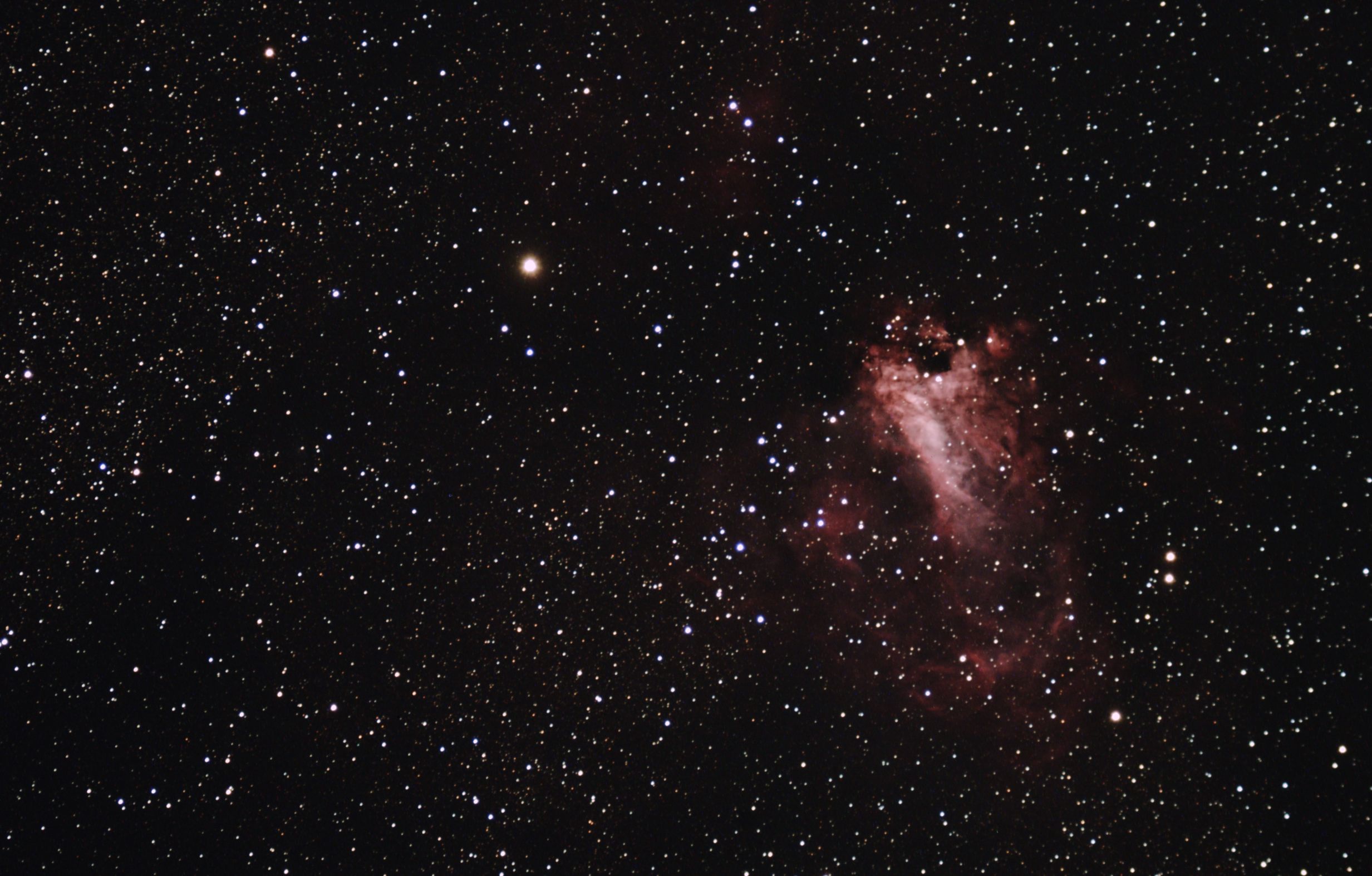
51. Messier 17, Omega or Swan Nebula
Notes: M 17 is one of a cluster of three star-forming emission nebulae in Sagitarius together with M16 (Eagle), which is only a bit more than two degrees to the north and M 8 (Lagoon), a few degrees further to the south. Their neighborhood is also populated by numerous young open clusters (Messier 18, 21, 24, 25, and others), which are associated with the nebulae — suggesting that they may have formed within the nebulae and drifted away — or which envelop the nebulae or even lie within and illuminate them.
M 17 has much in common with the better known M42 (Orion Nebula), even including its geometry.1 The two nebulae lie in distant sectors of the visible Galaxy in the northern hemisphere. The celestial coordinates of M17 are RA 18 20.8, DEC -16 10; those of M 42 are RA 05 35.3, DEC -05 23. Both are dense, star-forming clouds of gas and dust. They contain within them bright new stars that flood them with ultraviolet light, which ionizes hydrogen and oxygen and produces emissions in the red H-α and, in the case of M 42, the green O III wavelengths. This general similarity despite their wide separation shows that the scope of the processes that formed them is galactic, if not universal. Additionally, M 17 has up to 800 internal stars; Orion contains the young, open cluster known as The Trapezium. M17 has an angular size of 25 arcmin; M42 has an angular size of 66 arcmin. M 17 lies 4250 ly from the Sun; M 42 lies 1300 ly away. So they are similar in size as well.2,3
According to Wikipedia, an open cluster of 35 stars lies embedded within M 17.1 These hot young stars exite the gases of the nebula, causing them to emit light. In addition, hundreds more stars lie within and around the nebula. M 17 has a mass of 800 suns; Orion has a mass of 2000 suns. These masses fall within one order of magnitude. Both M 17 and M 42 belong to larger systems of nebulae and star clusters. They live in active sectors of the Galaxy and they are themselves busy neighborhoods. For further comparisons of these and other nebulae, see the page on NGC 6992.
References
1. Wikipedia, Omega Nebula, viewed on August 20, 2013
2. AtlasOfTheUniverse M16 and M17 – The Eagle and Omega Nebulae, viewed on August 20, 2013
3. AtlasOfTheUniverse, The Orion Nebula, viewed on August 20, 2013
Imaging: Repeated celestial alignment. Tightened focuser. The sky was dark, no breeze, some urban glow in south. The first chart readings in PHD were .13 to .14. The scope was carefully balanced in RA, slightly heavy to east, that is, within 1/4 inch of perfect balance. Stars in the first three frames were slightly oblong.
Zoom in/out with ⌘↑(+/-) (Mac), ctrl (+/-) (PC).