 |
50. Nova Delphini 2013
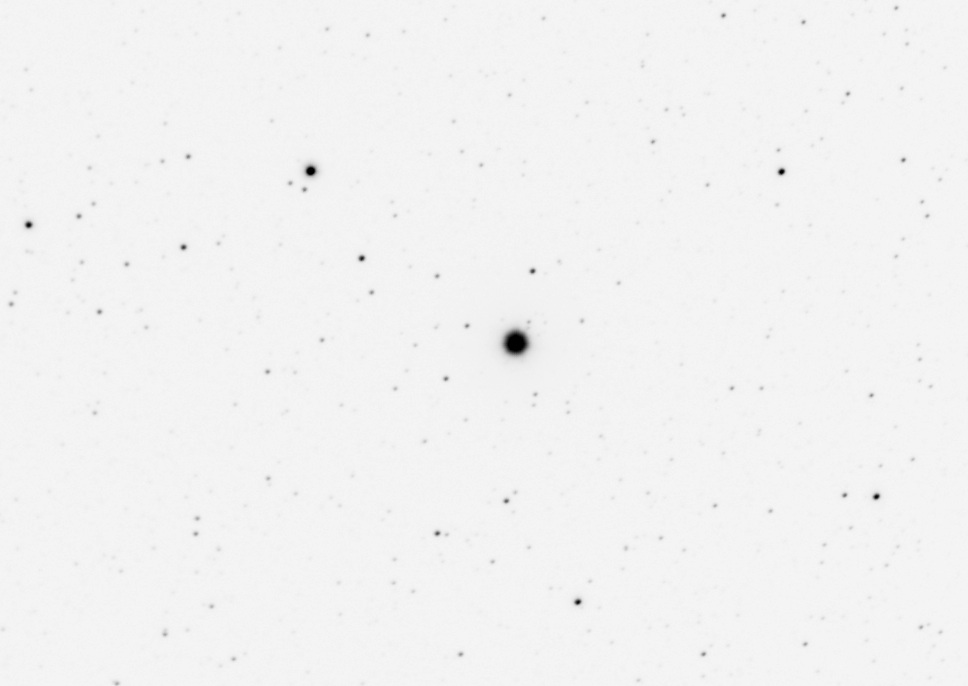
Notes: Nova Delphini 2013 is the prominent black dot near the center of our image. The nova was first noticed on August 14 at 2 p.m. EDT (1800 GMT) by amateur astronomer and entrepreneur Koichi Itagaki of Teppo-cho, Yamagata, Japan. Itagaki was using a 7 inch reflector, which is only a bit more than twice the aperture of our 80 mm. It's a small scope for such an exciting discovery.1 But there are amateurs and amateurs. Itagaki's web page on Wikipedia claims over 80 discoveries dating from 2001 to 2013.2 He has his own substantial observatory, named Nishizao (West-mountain) Observatory or Itagaki's Astronomical Observatory with four domes and several telescopes ranging up to 60 cm (~24"). Information on Itagaki and his observatory was contributed by Roy Ogawa.
Astrophotographer Ed Johnson has posted a revealing overlay of the nova against the pre-nova background. ND 2013 is located at RA 20 23 30.72 and DEC 20 46 03.4 near the constellation Delphini and the star Altair in the Summer Triangle, very high and slightly eastwards from the zenith early in the evening. It grew rapidly with an expansion velocity of 12000 km/s.3 It had an apparent magnitude of 17.64 on June 21. At that magnitude, it would probably not show up at all in this image. When discovered to be a nova by Itagaki, it had reached a magnitude of 15.7. Smaller numbers are brighter by about 2.5 times per unit, so at discovery it was already six times brighter than normal. By midnight of the 16th, it reached its apparent maximum of about 4.2, which is more than 130,000 times its normal intensity.4 An automatically generated light curve was posted by the American Association of Variable Star Observers.

How far away is ND 2013?. Distance estimates are hard to find. During a presentation by The Online Virtual Telescope Project on August 19, Gianluci Masi said there were no good measures, but he offered a rough estimate of 6000 ly.5 A search of NED by name, by the temporary designation PNVJ20233073+2046041, and by coordinates produced no information. A search of SIMBAD by coordinates produced the identifier TYC 1643-2104-1 -- Star, which is not recognized by NED, and an image that is not clearly pre-nova N Delphini 2013. In the SIMBAD image, ND 2013 should be one of the stars within 1 arcmin of declination (about 1/3 of the frame width). Based on declination and RA, it should be in the lower left quandrant. By comparing closely with Ed Johnson's image, using the arrow of five stars in that quadrant for orientation, we can see that in the SIMBAD image, the pre-nova binary is unluckily obscured by the label giving the image size.
For information on the formation and characteristics of novae, it is hard to improve on the informative and clear page on Wikipedia,6 but a nice description of the process is given in The Cosmic Perspective.7
A white dwarf is "dead" because it has no hydrogen left to fuse. This situation changes for an accreting white dwarf. The gas spilling onto an accreting white dwarf comes from the upper layers of its companion star and thus is composed mostly of hydrogen. The white dwarf's strong gravity compresses this hydrogen gas into a thin surface layer that gradually builds in mass as more and more material rains down from the accretion disk. Both the pressure and the temperature rise as the shell grows, and hydrogen fusion ignites when the temperature at the bottom of the layer exceeds 10 million K.
While burning hydrogen and helium drawn from a companion star, novae produce important elements of life, including carbon (atomic number 6), nitrogen (7), oxygen (8), and magnesium (12). Life makes heavy use of these abundant lighter elements, which are among the first produced in nuclear reactions in stars and novae. But the quantity of life-supporting materials added to the interstellar medium by the nebular ejections of novae is far less than the contributions of supernovae and of giant and red giant stars. The role of the novae of small binary stars is only to thicken the interstellar stew by a small percentage.
References Cited
1. http://www.space.com/22389-nova-star-explosion-delphinus-discovery.html, viewed August 16, 2013
2. Itagaki, viewed on August 17, 2013
3. Kopernik, viewed August 17, 2013
4. 100(17.64-4.2)/5; a first estimate posted here was too low by more than an order of magnitude; on calculation of apparent magnitudes; on magnitude of ND 2013, see Virtual Telescope, viewed August 16, 2013
5. See the New Nova Star Explosion Via Virtual Telescope Project space.com, viewed August 19, 2013
6. Wikipedia, Nova, viewed August 16, 2013
7. Bennett, J. et al., 2007, The Cosmic Perspective, 4th Ed. San Francisco: Pearson, p. 574.
Imaging: Roy Ogawa alerted us to the new nova on August 15. We weren't sure we had actually imaged the right star until Dave Buchla confirmed that the star patterns of our image matched those of images published on the internet. The camera settings seem about right, but in the future we would set them by using a calibration star of known magnitude close to that of the nova at the time of imaging. Unfortunately, August 16 is cloudy so we are unable to follow up.
Zoom in/out with ⌘↑(+/-) (Mac), ctrl (+/-) (PC).