 |
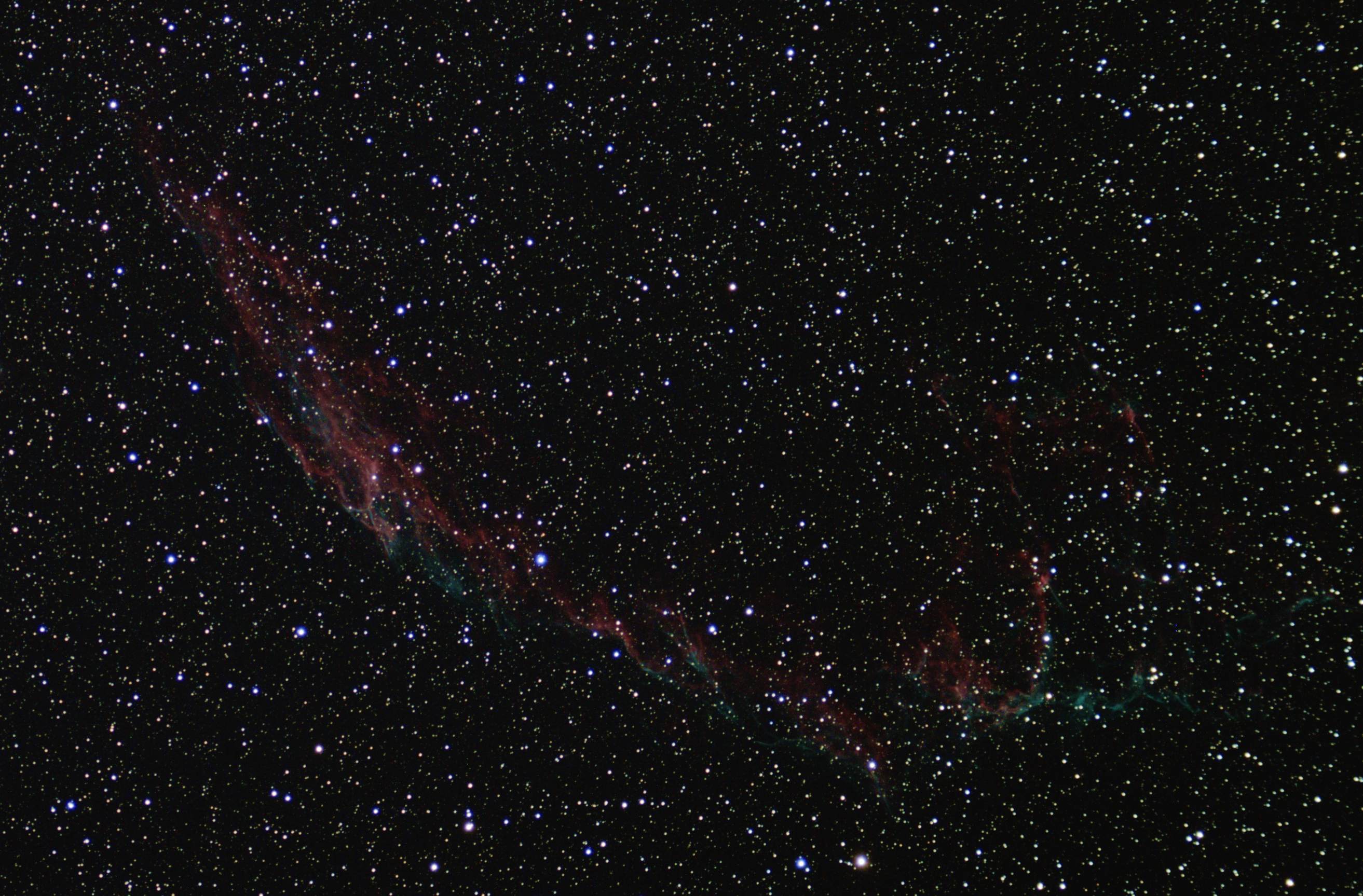
49. NGC 6992 Eastern Veil Nebula
Notes: In this image, we have captured only a part of the elephant. The large object to which it belongs is the Cygnus Loop, a ring of visible and invisible supernova remnants encompassing several degrees of sky. The dominant impression given by the image of NGC 6992 is of a wispy trail of gas extending over three degrees and florescing in the wavelengths of H-α (red, 656 nm) and O III (green, 501 nm). Sulpher (510 nm) adds to the green.1,2 Only about 2 degrees of the span are visible in this image. NGC 6992 looks wispy and gaseous compared to the massive clouds of gas and dust presented by NGC 7000 (North America Nebula) or IC 5070 (Pelican Nebula), because it consists of ejected remnants of a super nova rather than a cloud coalescing under gravitational attraction. It follows that the nebula is empty of new stars. In this nebula, you won't find star forming regions such as the Pillars of Creation in M16 (Eagle Nebula). Since NGC 6992 consists of remnants of a single star, there isn't nearly enough mass for even a single star nursery.
NGC 6992 bears a resemblance to NGC 6888 (Crescent Nebula), which consists of remnants of a red giant that started ejecting mass between 400,000 and 250,000 years ago. But the Crescent is much smaller, spanning only 18 by 12 arcmin. The difference gives an indication of the high velocity of a supernova, because the star that became the Cygnus Loop ignited just 5000 to 8000 years ago.3 Since it has a diameter of 90 ly, its average expansion velocity is somewhere between 1700 km/s and 2700 km/s. These average velocities are an order of magnitude lower than that of Nova Delfini 2013 at 12000 km/s. But for the Crescent, with a span of just 4.56 ly some 250 to 400 thousand years after the beginning of ejection, the average expansion velocity is just 1.63 km/s to 2.61 km/s, or two orders of magnitude lower than the estimates for the Cygnus Loop. Put bluntly, the Cygnus Loop and the Veil are larger and more dynamic than the Crescent, but the Crescent retains its generating star.
Table 1. Comparison of Cygnus Loop and Crescent Nebula to Nova Delfini 2013 by Span (in ly), Age (min and max in Ky), and Expansion Velocity (min and max in Km/S)
| Name | Ly | MinAge | MaxAge | MinVel | MaxVel |
| NDelp2013 | --- | <1 yr | --- | 12000 | 12000 |
| Cygnus Loop | 90 | 5 | 8 | 1700 | 2700 |
| Crescent | 4.56 | 250 | 400 | 1.63 | 2.61 |
Tony Finnerty raised the interesting question of why the green material appears on the outside of the Cygnus Loop. Is it because it consists of heavier particles with more momentum? Or is it because the heavier elements formed first during ignition of the supernova? We will try to answer this question and return with an answer.
Large emission and reflection nebulae, whatever their origins, are found in the plane of the Galaxy. NGC 6992 forms one visually disconnected side of the Cygnus Loop, which includes NGC 6960 (Western Veil), and Pickering's Triangle, which lies between the veils, but closer to 6960. To the north, but still in the Cygnus area, is NGC 7000, the North America Nebula, which includes IC 5070 (Pelican), and NGC 6888 (Crescent). Much farther on, past Polaris, in the distant constellation Perseus is NGC 1499 (California). Looking southward to the region of the constellation Sagittarius, including the Teapot, one finds in order M 16 (Eagle), M17 (Omega), M20 (Trifid), and M 8 (Lagoon). The center of the Galaxy is located in the direction of the star Sagittarius-α. We wonder whether the nebulae form a near continuous web (which we would view as a chain) around the disk of the Galaxy, or whether they are sparse and unevenly distributed. In following the progression in Table 2, it helps to note that from our viewpoint, the Milky Way is closest to Polaris at Cassiopeia, which lies between Cygnus and Perseus. At that point, one is going over the top and down the other side.
Table 2. Some prominent nebulae visible in the northern hemisphere in order along Milky Way by degrees of declination and constellation
| M 42 Orion | -05 | Orion |
| NGC 1499 California | 36 | Perseus |
| NGC 7000 North America w. Pelican | 44 | Cygnus |
| NGC 6888 Crescent | 38 | Cygnus |
| Cygnus Loop – Veil (this page) | 30-32 | Cygnus |
| M 16 Eagle | -13 | Serpens |
| M 17 Omega | -16 | Sagittarius |
| M 20 Trifid | -23 | Sagittarius |
| M 8 Lagoon | -24 | Sagittarius |
References
1. Wikipedia, Veil Nebula, viewed August 19, 2013
2. Wikipedia, Sulpher Lamp, viewed August 19, 2013
3. Wikipedia, Cygnus Loop, but compare APOD, Cygnus Loop, viewed on August 19, 2013
Imaging: The moon was over the Teapot, and by the end of imaging, it was low and red in the West. There was a very light breeze. The counter-weight was in the east. At the conclusion of imaging, the camera had almost hit the mount. We would have preferred to obtain more subexposures, but conditions deteriorated after the 15th. We don't image on both sides of the meridian because of the difficulty of aligning the subexposures after camera rotation.
Zoom in/out with ⌘↑(+/-) (Mac), ctrl (+/-) (PC).