 |
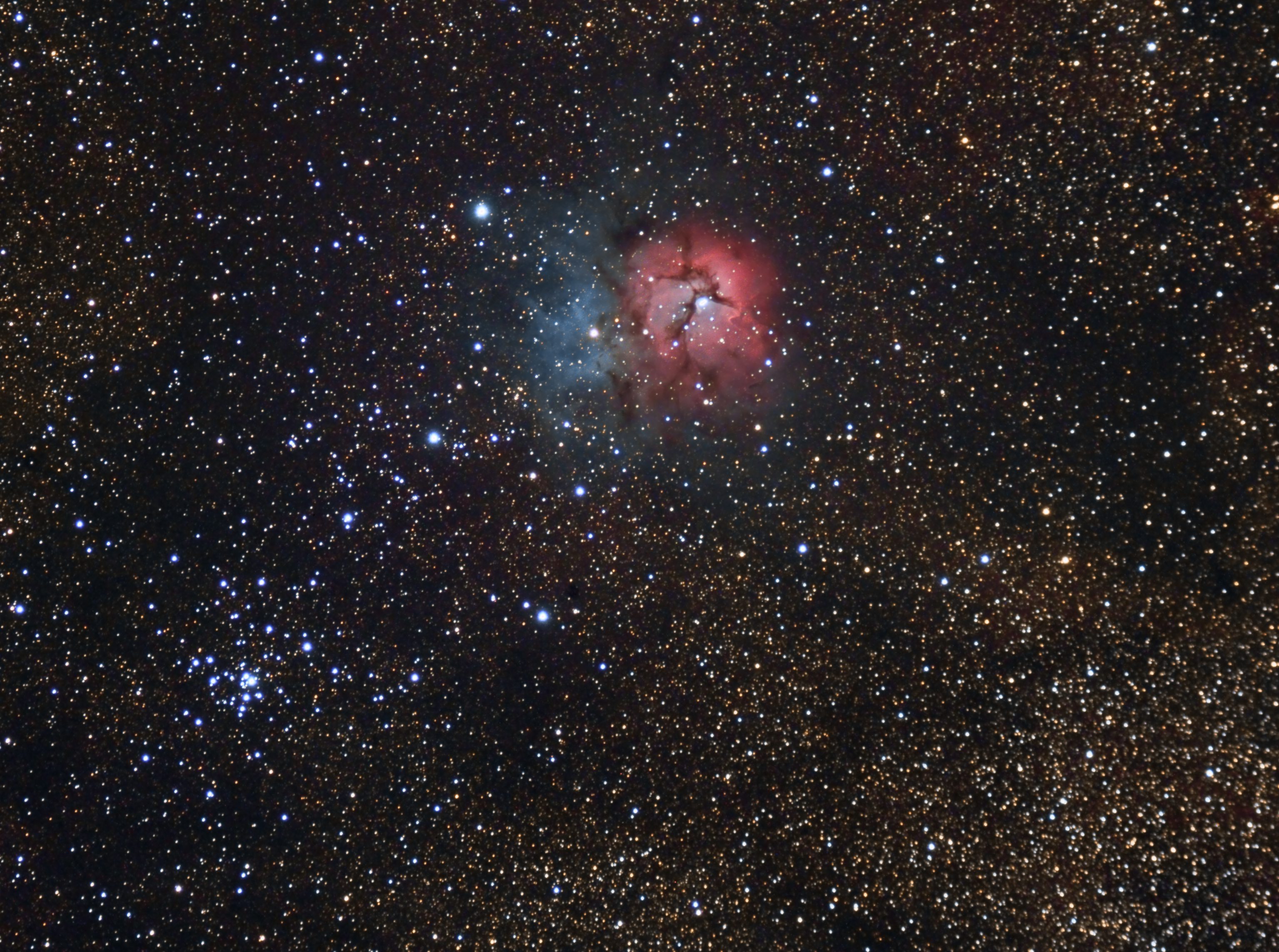
48. Messier 20, Trifid Nebula
Notes: M20 may be an overworked subject in astrophotography, but it's a very interesting spot in the Galaxy and it's right out there just a Little League pitch beyond the south deck. And it's a veritable teaching lab, presenting three separate light features—emitted, reflected, and obscured. The Wikipedia page characterizes the nebula as a region of molecular hydrogen gas—an H II region located in Sagitarius. The page displays a Hubble image taken through a variety of filters that pass emissions from hydrogen atoms, ionized sulfer atoms, and doubly ionized oxygen atoms. The text speaks of a lower, red portion (? periphery), which is emitting light. Our image is similarly oriented, but the red area is not confined to the lower portion, unless higher and lower refer to frequencies. The red is undoubtably H-α light at 656 nm emitted under the influence of ultra-violet radiation from stars, but which stars? Those inside the nebula or those in the surrounding open cluster? According to the NASA education site Cool Cosmos, a bright star cluster lies at the center of the emission nebula. The authors don't say that this cluster is responsible for the emissions, but it seems likely.1 In fact, the nebula contains 30 embryonic stars and 120 newborn stars.2
The Wikipedia page refers to the upper, blue portion (? central region) as a reflection nebula. The blue area is reflecting light from the surrounding open star cluster. Our image has a bluish tinge in the central region, but a much stronger blue cloud to the left (north) of the main cloud. Cool Cosmos says The blue reflection nebula to the north is unconnected with M20 and just happens to appear in the same field of view. The nebula appears blue because starlight is being scattered by interstellar dust particles.1 This interesting feature does not appear differentiated from M20 in the Hubble image. Apparently the reflected light failed the test of Hubble's three narrow band filters.
The black streaks and blobs may look like canyons and holes in the main gas cloud, but they are actually dust in front of the cloud. Can you see it? We've tried hard and we can't see it. They absorb light rather than emit or reflect it. Notice that any stars that might lay behind them are obscured by the dust. Just how thick is this dust? The figures will appear here at a later date. Tammy Plotner’s article on M20 has some interesting though puzzling observations on star formation and dust extinction. The Wikipedia page discusses other features that are difficult to distinguish even in a blowup of our image.

A feature that we have not seen discussed is the open cluster on the lower left of our full image at the top of this page. It would be difficult to prove by inspection, but it appears that the whole area between this obvious open cluster and the one in the immediate neighborhood of M20 could be construed as a single larger open cluster extending over one degree (~90 ly) or more of sky. If so, then perhaps M20 was once part of a larger cloud that produced the extended cluster.
Perhaps M20 gives us a key to the larger picture. Some five billion years ago, intergalactic clouds of gas and dust from the Big Bang and subsequent episodes of galaxy formation were set in rotation by gravitational forces and drawn into the plane of the Galaxy. Gravitation pressurized them causing them to precipitate clusters of stars arranged in trails that in the aggregate make up the arms of the Galaxy. Newborn stars emit ultraviolet radiation and cause the surrounding gas to emit light in all the wave lengths of the ionizing atomic and molecular elements within the cloud, elements such as hydrogen, sulfer, and oxygen. Old stars left behind by the process shine on the remaining gas clouds revealing them in the blue wavelength of scattered, reflected light much like the daytime atmospheric light of the sky. Clouds of molecular dust containing molecules of oxygen, sulfer, carbon, nitrogen, and organic molecules remain interspersed with the hydrogen gas and provide nurseries for the formation of solar systems containing heavier metals. Galaxies collide, setting up shock waves that cause more intense star formation. In the course of time, some of the matter from giant or dying stars blows out to form shock wave emission nebulae such as NGC 6888 (Crescent Nebula) or supernova remnants such as NGC 6992 (Veil Nebula), which consists primarily of oxygen, sulfer and hydrogen. Some stars just burn out and become brown dwarfs. Whole solar systems and clouds of matter are gobbled by the black hole at the center of the Galaxy.
There is a lot going in in the Galaxy and the other galaxies strewn in the billions around the visible universe. The fact is that humans could only evolve in a solar system that contains some of the elements we have mentioned, carbon, oxygen, and nitrogen in particular. We have arrived at the show just when the show is at its best. But human life seems so fragile that chances are good we will only get a short peek at it and we will miss the third act in which the universe winds down. That's as far as we can see.
References
1. http://coolcosmos.ipac.caltech.edu/cosmic_classroom/
multiwavelength_astronomy/multiwavelength_museum/m20.html
2. Wikipedia, Trifid Nebula, viewed on August 6, 2013.
Technical Notes: After a viewing session, we rebalanced and refocused. The initial results were very poor, with oblong stars. We balanced more carefully, closer to perfect balance but maintaining an eastward bias, and obtained the results seen in this image. We suspect that further improvement will require adjusting the tightening knob on the focuser to eliminate sag.
Zoom in/out with ⌘↑(+/-) (Mac), ctrl (+/-) (PC).