 |
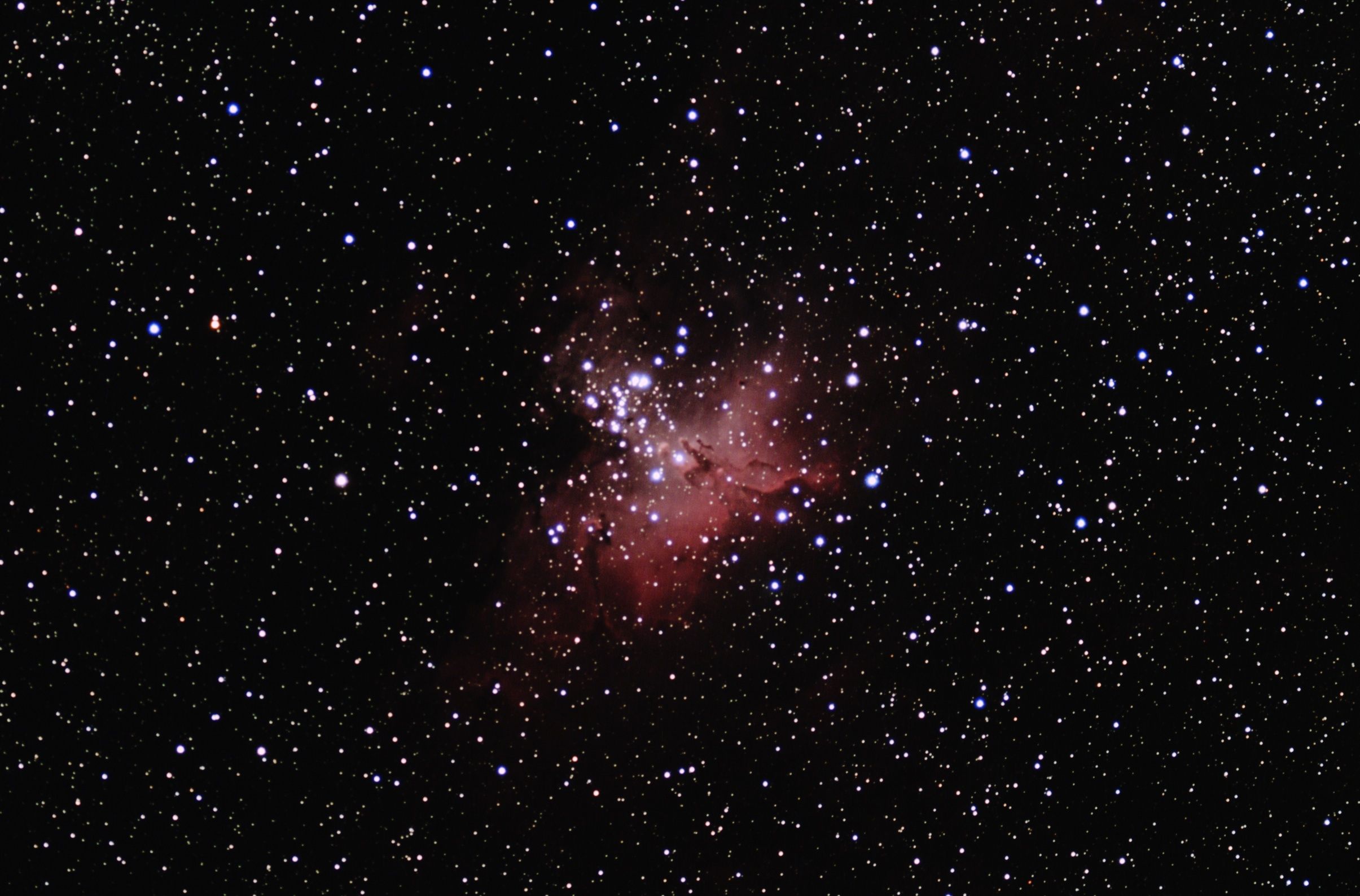
47. Messier 16, Eagle Nebula
Notes: The famous Pillars of Creation can be seen in this image, though not looking much like the renowned Hubble images. Still, it is nice to know that you can see the real thing with a small telescope. But we may not be seeing the real thing at all, only a remnant image of a former thing. According to a 2007 report by the Jet Propulsion Laboratory, the pillars may no longer exist.
A new, striking image from Spitzer shows the intact dust towers next to a giant cloud of hot dust thought to have been scorched by the blast of a star that exploded, or went supernova. Astronomers speculate that the supernova's shock wave could have already reached the dusty towers, causing them to topple about 6,000 years ago. However, because light from this region takes 7,000 years to reach Earth, we won't be able to capture photos of the destruction for another 1,000 years or so.1
Presumably, the shock wave from the supernova took 1000 years to reach the pillars. The supernova itself is disputed.2
Wikipedia says those pillars of gas were 9.5 ly long3. That sounds like a long distance. To put it in some perspective, the diameter of the Galaxy is 150,000 ly and the distance from the earth to the sun is a tiny fraction of one light year (8 minutes over the number of minutes in a year; you figure it out.) Wikipedia gives a radius for M 16 of 70×55 ly (cluster 15 ly). As with most of the large emission nebulae, there is an associated star cluster. This one has 460 stars.
As emission nebulae in the constellation Sagittarius go, the Eagle is distant, as shown in the table, but it groups with M17 in its angle of galactic longitude (l). But that just tells us what we can see from a deep sky chart: That M 16 is near M 17 and M 20 is near M 8. As we scan southward "down" the Milky Way at this time of year, we are looking at sectors of decreasing galactic longitude as we approach the direction of the center of the Galaxy and zero longitude. The small numbers for the b (galactic latitude) coordinate show that the nebulae lie near the plane of the Galaxy. The Trifid lies just 14 ly below the exact Galactic plane. The positions of the nebulae and star clusters are displayed very nicely in the last map on the Wikipedia page for the Orion Arm.
Table. Prominent emisson nebulae in the constellation Sagittarius by galactic coordinates, size, and distance5,6
| Name | l° | b° | Size (Ly) | Distance (Ly) |
| M 16 Eagle | 17.0 | +0.8 | 13 | 5700 |
| M 17 Omega | 15.1 | -0.8 | 40 | 4250 |
| M 20 Trifid | 7.0 | -0.2 | 25 | 4000 |
| M 8 Lagoon | 6.0 | -1.2 | 55 | 4350 |
References
1. Famous Space Pillars Feel the Heat of Star's Explosion, JPL, viewed August 20, 2013
2. Pillars of Creation, Wikipedia, viewed August 21, 2013
3. Eagle Nebula, Wikipedia, viewed August 21, 2013
4. Orion Arm, Wikipedia, viewed August 21, 2013
5. M16 and M17 – The Eagle and Omega Nebulae, Atlas of the Universe, viewed on August 22, 2013
6. M8 and M20 — The Lagoon and Trifid Nebulae, Atlas of the Universe, viewed on August 22, 2013
Zoom in/out with ⌘↑(+/-) (Mac), ctrl (+/-) (PC).