 |
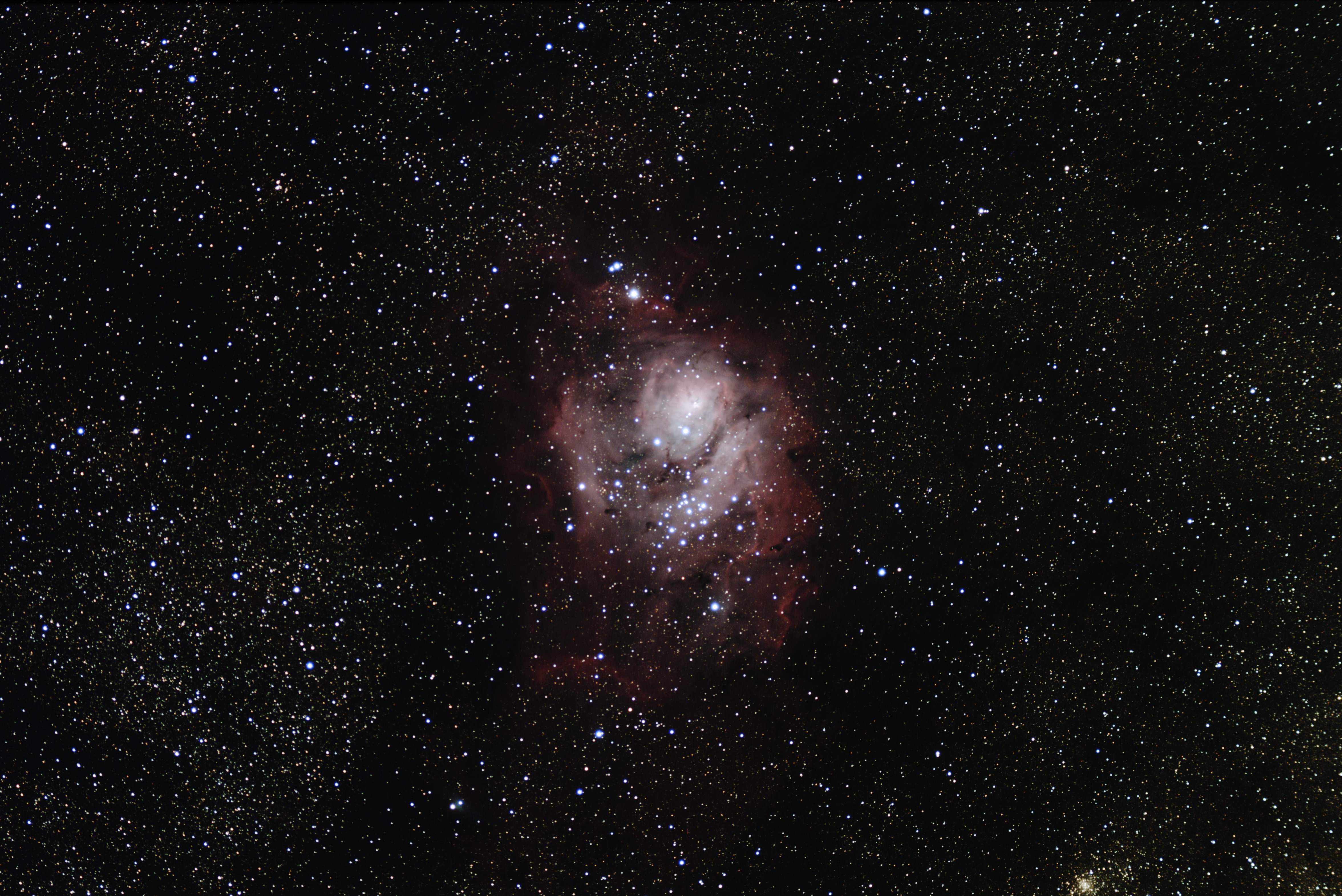
46. Messier 8, Lagoon Nebula
Notes: After imaging two emission nebulae in the constellation Cygnus and learning about other nebulae in that region, we decided to swing the scope around to the south and see if we could align from there. We anticipated problems, because our view of Polaris is blocked by the house. More on that in the Technical Notes section below.
Messier 8 is an emission nebula in the constellation Sagitarius, so it is found in the general direction of the Galaxy center, but of course, it is only 4,100 ly away, whereas the Galaxy center is about 28,000 ly distant. Does this mean that M8 lies in the Orion spiral arm of the Galaxy like the nebulae in Cygnus (IC 5070, NGC 6888), or are we looking into another arm?
Among the first things to catch our eye were the three, well defined dark patches that show up around the dark gray region below the light core. Other dark patches can be found here and there. According to Wikipedia, those patches are "Bok globules (dark, collapsing clouds of protostellar material)".1 Since they are collapsing, we presume that stars are forming there. We suspect there are as yet no new stars in the globules, because new stars might blow out the dust and gas, as one did in the Cocoon Nebula IC 5146 about 100,000 years ago.2 However, star formation is occurring within the region of M8 known as the Hourglass Nebula. The hourglass shape does not show up well in our image, but the outline can be made out faintly as the brightest spot of the M8 gas cloud. The gas formation of the Hourglass is irradiated by the embedded star just above it, O Herschel 36. This region is also the site of intersteller tornadoes revealed by Hubble images.3 According to the Australian Astronomical Observatory, the bright star cluster in front of M8 was recently formed, but the action has now shifted to the region of the Hourglass.4
References
1. Wikipedia, Lagoon_Nebula, viewed Aug 2, 2013.
2. http://www.universetoday.com/15412/the-cosmic-cocoon-ic-5146-by-tom-v-davis/, viewed Aug 2, 2013.
3. http://messier.seds.org/more/m008_hst.html, viewed Aug 2, 2013.
4. http://www.aao.gov.au/images/captions/uks005.html, viewed Aug 2, 2013.
Technical Notes: With the scope positioned on the south deck, it was necessary to do the two star alignment without benefit of Polaris. We used a compass to point the tripod and mount in the direction of Polaris and, after leveling, proceeded to the two-star alignment, which required a bit of manual repositioning of the tripod, but was not difficult. When we attempted the polar alignment, we discovered that NexRemote slews to Polaris, so we quit NexRemote, turned off the mount, and started over using the manual remote, which allows one to use any visible star for polar alignment. This worked well, except that for reasons we don't understand, the manual altitude setting is now at 40° rather than our latitude of 39°. After completing the polar alignment, we turned the mount off and on again and used NexRemote to do a two-star calibration.
We have just realized after two years that biases should not be subtracted from the lights, because the darks also contain bias error. When the darks are subtracted from the lights, bias error is removed at the same time. If the biases were subtracted again, we would actually be reintroducing the error. So we just subtract the biases from the flats, and subtract the debiased flats and the biased darks from the biased lights. Most of the smaller stars in this image have a green cast. We suspect urban light pollution from Sacramento and Auburn to the south. There may also be some influence from the moon. Zoom in/out with ⌘↑(+/-) (Mac), ctrl (+/-) (PC).