 |
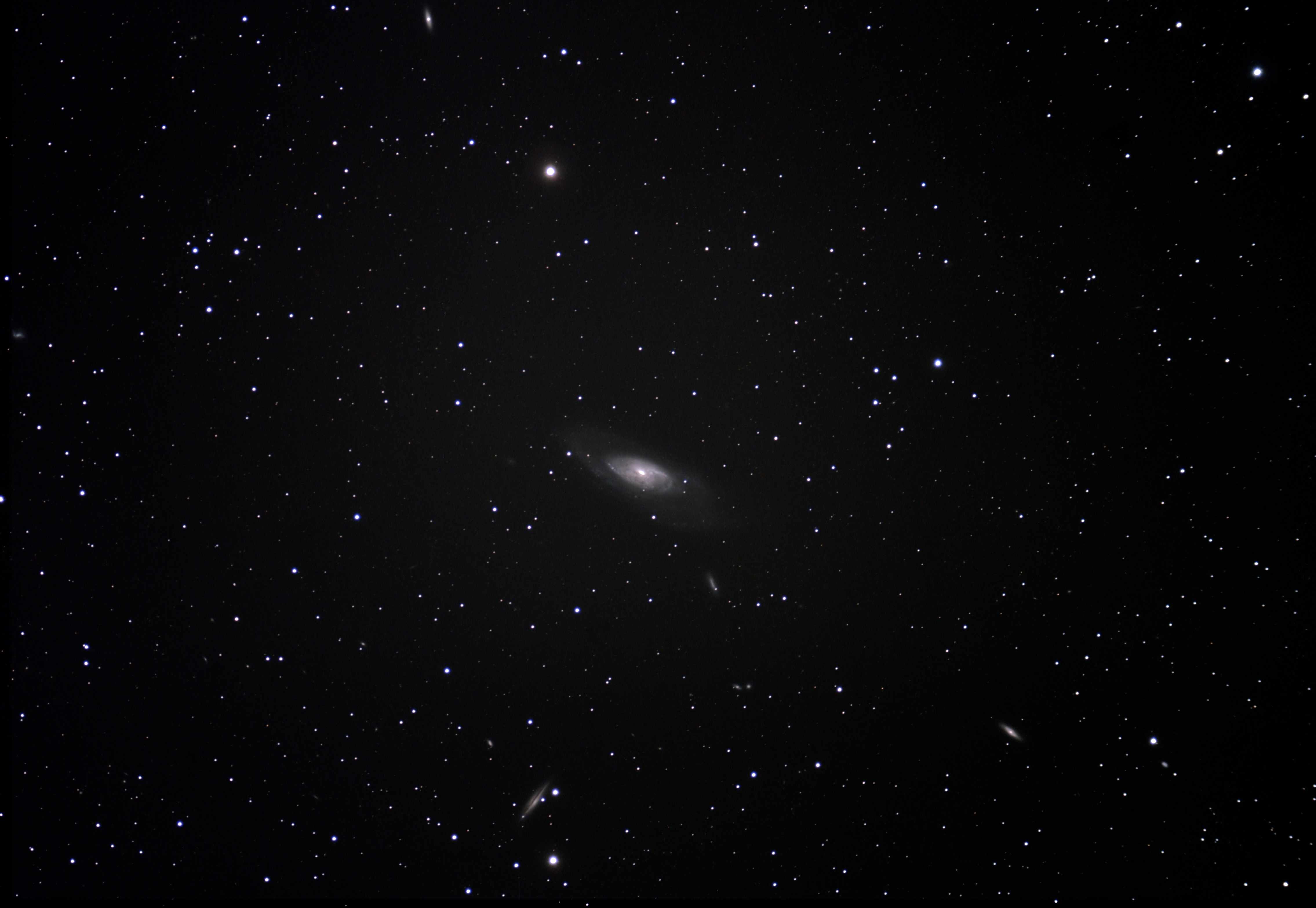
43. NGC 4258 (Messier 106)
Notes: If you ever need to warm up a pizza the size of a galaxy, NGC 4258 is the right appliance. It functions like a giant laser, except it collimates microwaves, which makes it a maser. The collimation is done somehow by water vapor, perhaps acting on microwaves generated by the core. So it is a water vapor maser that beams microwaves or "water maser" for short. According to Wikipedia, evidence for the maser "is seen by the 22-GHz line of ortho-H2O that evidences dense and warm molecular gas". We wonder how much water the galaxy contains and whether the galaxy's solar and planetary systems might also have abundant water.
NGC 4258 lies in the constellation Canes Venatici just a few degrees above (south of) Ursa Major. It is a weakly barred spiral galaxy lacking rings. Its mass has been estimated at 33 million ± 0.2 solar masses (Astrophysical Journal 693 (2009) 946). Comparing it to our own Galaxy, which weighs 1.0 to 1.5 trillion solar masses, we see that NGC 4258 is less than one hundred thousandth the mass of the Milky Way. It seems a wonder that we can see it at all. Just the black hole of NGC 4258 is estimated at between 24 and 36 million solar masses. That doesn't seem to leave a lot of remaining mass for the disk. X-ray and radio data reveal internal structure not shown by visible light. A photo by NASA's Chandra X-ray observatory shows otherwise invisible spiral arms formed by shock waves from jets emanating from the core (Image). See also the combined image by NASA, Gendler, and GaBany. The two bright dots at the upper left of the inner disk appear to be star clusters within NGC 4258. They can also be seen in the NASA, Gendler and GaBany image. The bright dot on the edge directly below the core may be another cluster.
At least seven other galaxies can be seen in our wide field image, including NGC 4217 on the lower left (NNW).
Technical notes: The nights were dark with breezes from 0 to 6 or 7 mph and a late rising moon or changing to no moon at all. Subexposures showing moonglow were discarded. Temperatures at start of imaging ranged from 63°F to 81°F. Darks were taken immediately following the subexposures and ranged from 7° to 0° cooler than corresponding subexposures at start. This is our first image taken using a field flattener, so the stars on the margins are rounder. The first image we posted on this page had good contrast and detail in a few places, but Steve (Nighthound) on the Photography-on-the.net forum on Astronomy and Celestial Talk showed that the dark end had been too heavily clipped. The second version retained a little haze but showed more of the outer ring while having almost the same contrast. A third version taken with 12 minute subs over a shorter total time has better contrast, but showed less of the rings.
The current image combines all 94 subexposures of NGC4258/M106 taken at ISO 800 over 8 nights of viewing. Half were exposed for 10 min each and half for 12 min each. We made and processed stacks consisting of (1) all 10 min, (2) all 12 min, (3) a stack of those two stacks, and (4) the final stack of all 94 subexposures together. All the post processing was done in Nebulosity using color background (offset), levels, curves, color balance, and a bit of cropping at the margins. There was nothing scientific about this process. I tried not to clip excessively and I poked and prodded the curve to keep faint structures while also maximizing contrast and brightness of the subject. There are tradeoffs. The resulting image can never be perfectly duplicated by reprocessing.
The two best images came from the 10 minute stack of 47 subexposures and the final stack of 94. Without zooming, the image from the 10 minute stack looks as good as or slightly better than the full stack, but with zooming it is clear that the outer ring of the full stack of 94 is less grainy. The image made with the full stack does fairly well at preserving structure under the seven zooms allowed by the Google Chrome browser.
Conclusion: An increase from 10 to 12 minute sub exposures did not result in a markedly better or worse image, but doubling the total time from ~9 hrs to ~19 hrs did result in a smoother image. The small improvement in results was a little disappointing, but still nice to have. Zoom in/out with ⌘↑(+/-) (Mac), ctrl (+/-) (PC).