 |
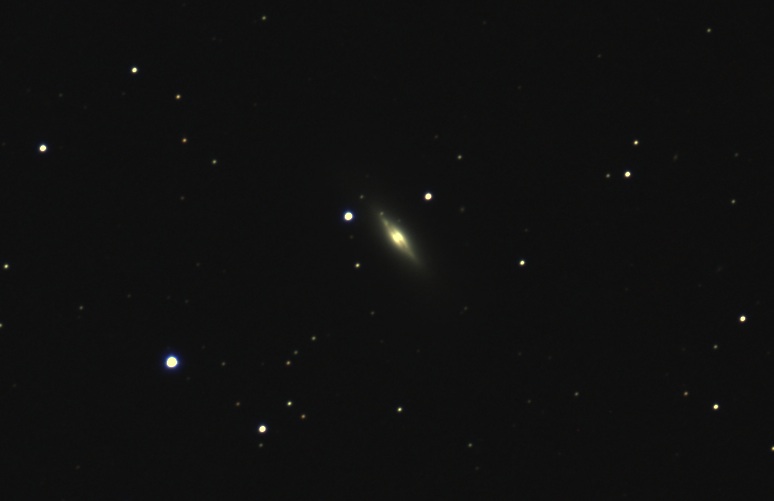
41. NGC5866 (Messier 102)
Notes: At apparent magnitude of 10.7, NGC 5688 is really too dim for an 80 mm refractor and DSLR, but we wanted to find the limits. We can see the core, a line of dust that bisects the galaxy, and what is probably a ring or halo visible as a glow that surrounds it all. There is even a bit of structure on the NW end. This image is cropped to roughly 1/5 the width of the original. Our full frames are 119 arc minutes on the long dimension. In this image, NGC 5866 is roughly 2 arcmin from end to end as measured in the software program Nebulosity. So we are getting interesting detail from an image that is just under 2 percent of the camera frame in lineal dimensions and .04 percent in area. For only a billion dollars more, one can get exquisite detail along the dust line as seen in the Hubble image. Of course, for considerably less than that, one might also get a better image using an eight or ten inch reflector and a CCD camera.
Technical Notes: The stack comprises 34 subexposures at 15 min each, which sums to 8.5 hours. The half moon was near the meridian when tracking began at 9 pm. It is likely this image would have been significantly more clear taken on a moonless night. A light wind after midnight of the 19th did not noticeably affect tracking, though we did not compare charts. Zoom in/out with ⌘↑(+/-) (Mac), ctrl (+/-) (PC).