 |
40. Messier 94
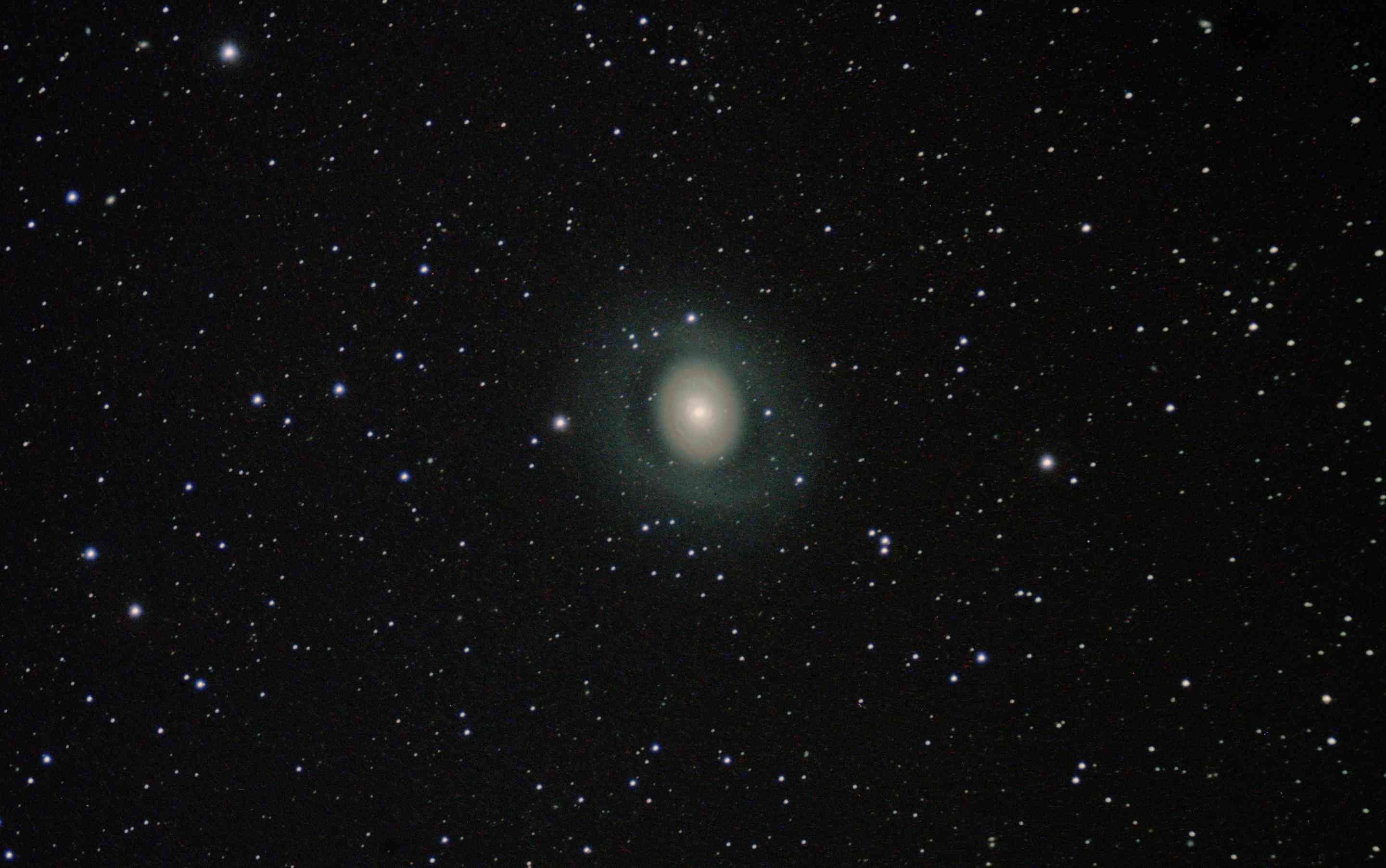
Notes: M94 is a spiral galaxy in the M94 Group of the Virgo Supercluster. It has two concentric rings and a "low ionization nuclear emission region (LINER) nucleus." (http://en.wikipedia.org/wiki/Messier_94, viewed on February 13, 2013) We are not sure if this means that other galaxies might have a high ionization nuclear emission region (?HINER), or that they might lack ionized gas in the nucleus. We quote Wikipedia's interesting comments on the rings:
M94 contains both an inner ring with a diameter of 70" and an outer ring with a diameter of 600". These rings appear to form at resonance locations within the disk of the galaxy. The inner ring is the site of strong star formation activity and is sometimes referred to as a starburst ring. This star formation is fueled by gas that is dynamically driven into the ring by the inner oval-shaped bar-like structure.
The SEDS (Students for the Exploration and Development of Space) page states that the star population of the outer ring is less bright, older, and yellowish. (http://messier.seds.org/m/m094.html, viewed on February 13, 2013)The SEDS and Wiki articles do not entirely explain what we see in our image. We see five structures: (1) an inner bright core surrounded by (2) a bright ring which is perhaps the aforementioned site of massive bright star formation, surrounded by (3) a disk on which we see (4) an apparent ring of reddish dust, then a gap, and (5) an outer diaphanous ring. It may be that the outer ring and gap are regarded by others as part of the disk, which they may refer to as the outer ring.
Other comments in the Wikipedia article indicate that M94 is unusually active with star formation regions in the rings, and that the central ring and oval core take the place of what would be a central bulge of older stars in other spiral galaxies. M94 also challenges theories of galaxy origins by virtue of its apparent lack of dark matter as deduced from the rotation curves of its stars and the density of its hydrogen gas. Zoom in/out with ⌘↑(+/-) (Mac), ctrl (+/-) (PC).