 |
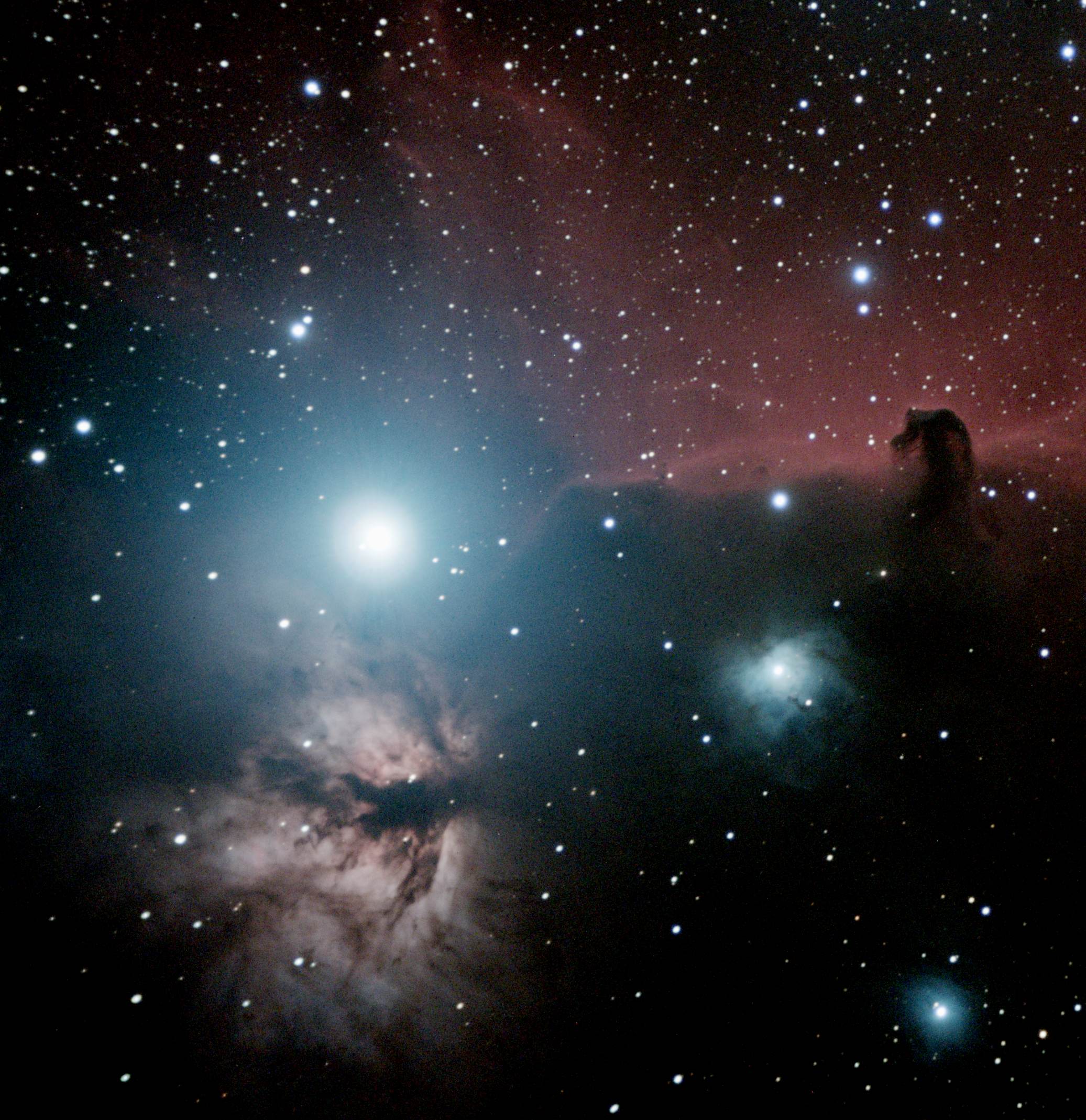
36. Bernard 33, Horsehead Nebula in IC 434
Notes: Nigel Sharp writes that "Polarization maps suggest that the entire region is illuminated by the bright OB star Sigma Orionis, which is also responsible for exciting the emission nebula" (www.noao.edu/image_gallery/html/im0057.html, Viewed Feb 9, 2013).
Sigma Orionis is actually a 5 star system, which has at its core a pair of hot, young stars, designated A and B, which radiate about 35,000 and 30,000 solar luminosities, respectively, onto the gas around the nebula, causing the pink glow. A and B are "hydrogen-fusing dwarfs only a few million years old" (en.wikipedia.org/wiki/Sigma_Orionis). The bright stars in this image are blue and probably young. Sigma Orionis is located to the immediate southwest (right and below) the leftmost star in the belt of Orion, which is Zeta Orionis (Alnitak), the bright star in this image. The distances of these objects from the Solar system are:
| Alnitak (Zeta Orionis) | 700 ly |
| Sigma Orionis | 1150 ly |
| Bernard 33 (Horsehead Nebula) | 1500 ly |
Stark describes the neighborhood as one of "low-mass star formation" containing "hidden protostars," "jets of material ejected from protostars", and magnetic fields with outflowing matter undergoing photodissociation (molecular breakdown caused by light). It's a dynamic and complex neighborhood.
Technical Notes: We sent the CGEM to Torrence for repair of a connector and checkup. Barnard 33 was our first target on getting the mount back from Celestron. Our first try was done without polar alignment, because we had previously noticed that very good polar alignments were producing eggy stars. Our results on the first night were very bad, with stars stretched vertically only on the left side of the frames and having a slight rotation around the center. The pattern suggested a problem with polar alignment, so the next night after the two-star alignment, we did a manual polar alignment, but not a perfect one. We left Polaris resting a bit to the NE on the line of the inner bullseye in PHD Guiding. Then we switched the mount off and on to kill the previous two-star alignment and repeated the two-star alignment with calibration stars. The results are seen in this image.
The first seven subexposures were shot through a gap in tall pine trees. Then Orion went behind a large pine. When it emerged, we had to reslew to a position that rotated the camera 180 degrees. We took seven more subexposures. When we stacked them, we lost about half the width of the image, leaving only the left half that you see in the image above. The loss of so much of the frame width forced us to keep the margin where the stars are distorted. This kind of distortion could be mitigated with a field flattener. The stars on the right hand side of the image are good, showing that the mount is tracking well.
The coloration in this image is dramatic and unaltered, but much of the structure is obscured by darkness. A much longer exposure, perhaps 20 hours, with a Hydrogen alpha filter would reveal more detail. A stack of filtered subexposures can be overlaid on a full color image, as in this spectacular and revealing image posted by NASA and the Star Shadows Remote Observatory. Zoom in/out with ⌘↑(+/-) (Mac), ctrl (+/-) (PC).