 |
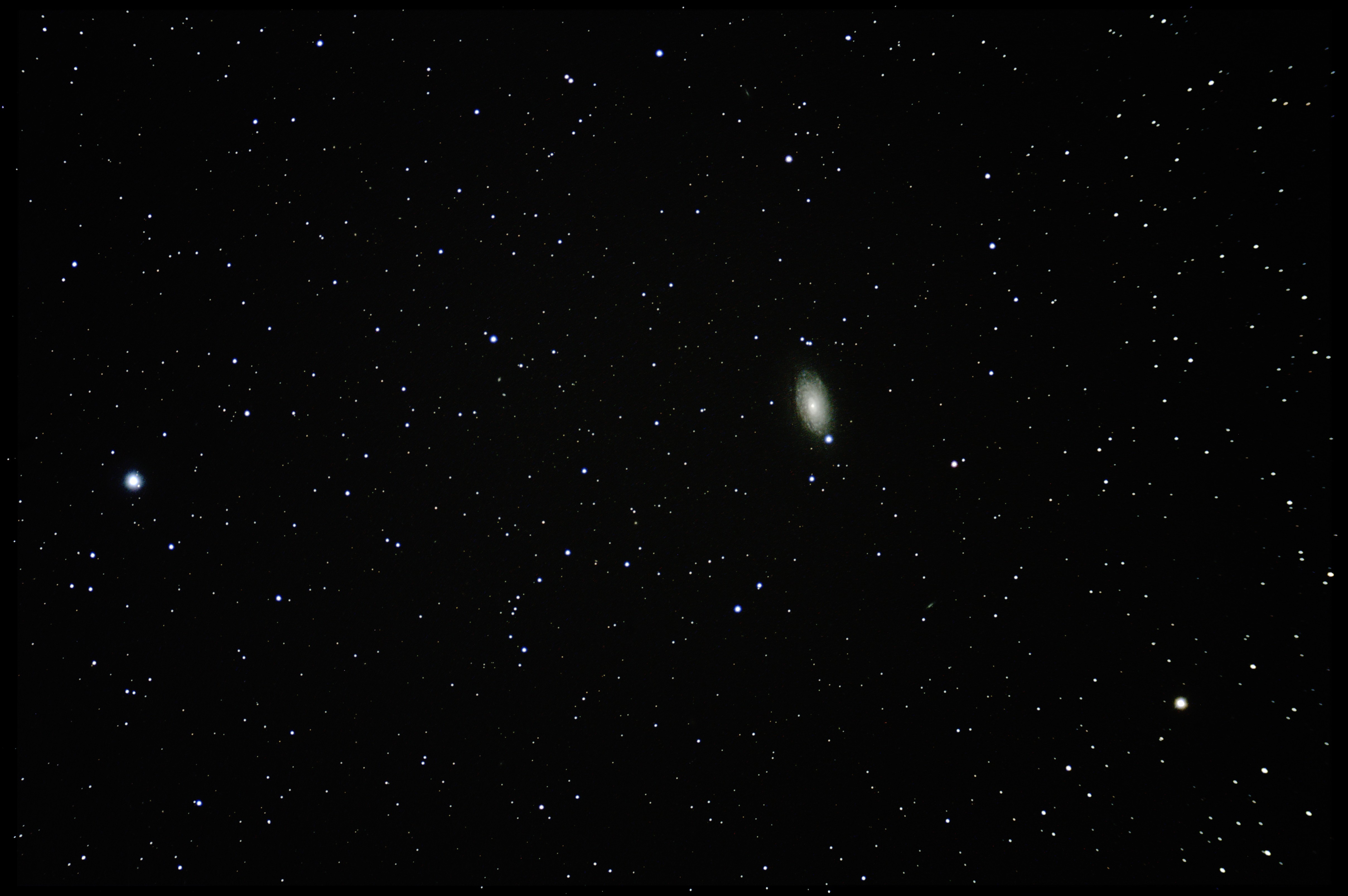
27. Messier 63, The Sunflower Galaxy
Notes: Images of deep sky objects appearing on web sites are commonly cropped close to the object, leaving relatively little visible background sky. These images, such as this one of M63 taken by Tony Hallas with a 14.5 inch telescope and posted by NASA, are often highly detailed and reveal many interesting objects in their immediate neighborhood. In Hallas's image, there are at least eight galaxies that either do not appear in ours or appear only as points not distinguishable from stars. His image reveals much more of the disk. Bear in mind that Hallas's image is rotated 90 degrees counter-clockwise from ours. But one of the advantages of taking your own images is that you see them before the crop, and since our telescope is small, it has a wider field of view. Often, objects appear in an uncropped frame as interesting surprises that we might otherwise never see. In our image of M63 there are two additional bright elliptical galaxies and possibly two faint galaxies beyond the cropping border of Hallas's image. If we place the Cartesian origin (0,0) in the center of M63, and zoom in until the screen image is about 24.5 cm high, which is about the height of a 17 inch screen, we find the bright galaxies at roughly (-17,-1) and (9,-8) in centimeters. They are prominent even without the zoom on the far left and lower right. The faint ones, if they really are galaxies, appear at (-1,8) and (2.5,-5).
This seems a good point to list and compare the closer galaxies that appear on this site. The table below displays the obvious correlation of distance and positive radial velocity (heading away from us), which is calculated from the shift of an object's radiated light to lower frequencies. We can use the figures in the Span column to calculate that M51a and M63 occupy only about 150th the field of view occupied by M31. M31 stands out in size and brightness.
| Galaxy | Dist | 109☉ | Mag | Span | RadVel |
| M31 Andromeda | 2.5 | 1000 | 3.4 | 190′x60′ | -301 |
| M33 Triangulum | ~3.0 | 50 | 5.7 | 71′x42′ | -44 |
| M81 Bode's | 11.8 | 50 | 6.9 | 26.9'x14.1' | -34 |
| M101 Pinwheel | 21 | 100 | 7.9 | 28.8′x26.9′ | 241 |
| M51a Whirlpool | 23.4 | 160 | 8.4 | 11.2′x6.9′ | 463 |
| M63 Sunflower | 37 | 140 | 8.6 | 12.6′x7.2′ | 504 |
Distance (Dist) is given in millions of light years. Mag is apparent magnitude. Larger numbers index fainter objects. ☉ is solar mass. We give the mass values in billions of solar masses. Span is given in arcminutes. RadVel is radial velocity, given in kilometers per second. A positive value indicates an object moving away from the Milky Way.
Technical Notes: The 13 subexposures that we chose to use in the stack came from a total of about 50 taken on 5 nights over the span of a week. We are finding it difficult to get round stars. We have trained the CGEM with a batch session of 5 runs. We have balanced on two axes and weighted on the east side. We also shifted a bit of weight to the camera end of the scope. We have tightened and taped possible sources of wiggle and flex. We have a good polar alignment, possibly too good, as it doesn't require much work from PHD Guider. We have made various small adjustments in PHD. Our settings are RA aggressiveness 100, RA Hysteresis 10, Max RA duration (ms) 400, Search regions (pixels) 15, Mn. motion (pixels) 0.15, Dec guide mode Auto, Dec. Algorithm Resist Switching, Dec slope weight 5.00, Star mass tolerance 0.50, Noise reduction None. We are not sure how some of these settings, such as RA Hysteresis, Dec slope weight, Star mass tolerance, and Noise reduction, might affect our results. So many variables come into play---e.g. wind, clouds, target location and scope position---that it seems difficult to isolate the effects of each adjustment.
The main source of tracking error appears to be wobble in the declination axis. Wobble in DEC appears in the images of stars as a bulge on the horizontal axis. Evan theorized that we needed to imbalance the weight on the DEC axis to give the motor something to work against. With our current polar alignment, the DEC correction in PHD Guiding is predominantly south. We read this under the guiding window during the guiding. M63 is in the northwest. Guiding south should mean that the guide star appears to climb. The scope, which is polar aligned slightly eastward, wants to dive relative to the guide star as both rotate westward, so the scope is guided (and lifted) upward (south) to follow the guide star. (see diagram from previous message). We moved the scope forward on the mount about 1/4" from perfect balance to create a small forward imbalance. This did not appear to affect focus. There is no reason why it should so long as the focus stop screw is tight. The result was that the DEC error appeared on the PHD chart as square drops to -1 pixel lasting for a few seconds and returning to near zero with an irregular frequency pattern of roughly one per minute. This was a different pattern than the large up and down variations on 3 minute intervals that we have seen with the scope weighted on the camera end. The frames appeared to be sharper the first time we tried this, but we still we able to use only 3 out of 10. These three frames came from near the end of the run (just before the actual end of the run which hit the tree tops). The half flux values of the three useable subexposures were not particularly good (2.39 to 2.81), probably because they were taken near the horizon, but the stars were nearly round. Perhaps the tracking was better on the late subexposures because, at this low angle, the imbalancing on the DEC axis was most effective. This argues for additional imbalancing closer to the meridian. Zoom in/out with ⌘↑(+/-) (Mac), ctrl (+/-) (PC).