 |
26. Finding the best focus using Vega as an example
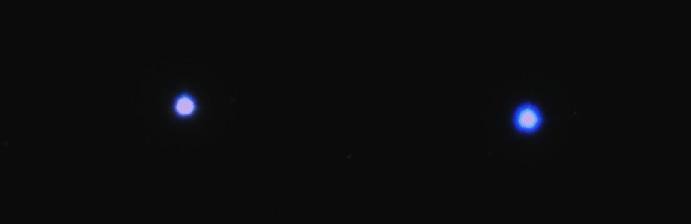
Notes: For the purpose of focus, all the stars except the Sun are at infinite distance. Good focus on one star transfers to all deep sky targets. Our refractor is not apochromatic, so it has obvious coma (blue margin) around stars. Coma is especially evident on bright and large stars, such as Vega, which has the mass of 2.1 Suns, a radius of roughly 2.7 times the radius of the Sun, and is only 25 ly distant. There is one focus point where the diameter of the coma around Vega is at minimum size on our computer screen, as seen in the image on the left. There is another focus point where the diameter of the coma is larger, but the diameter of Vega itself appears to be at a minimum, as seen in the image on the right. In this case, neighboring small stars also appear brighter and more clearly defined, but none were close enough to include in this composite. We chose maximum coma size with minimum star size as the focus point for our main target, which was M63, The Sunflower Galaxy (27). Zoom in/out with ⌘↑(+/-) (Mac), ctrl (+/-) (PC).