 |
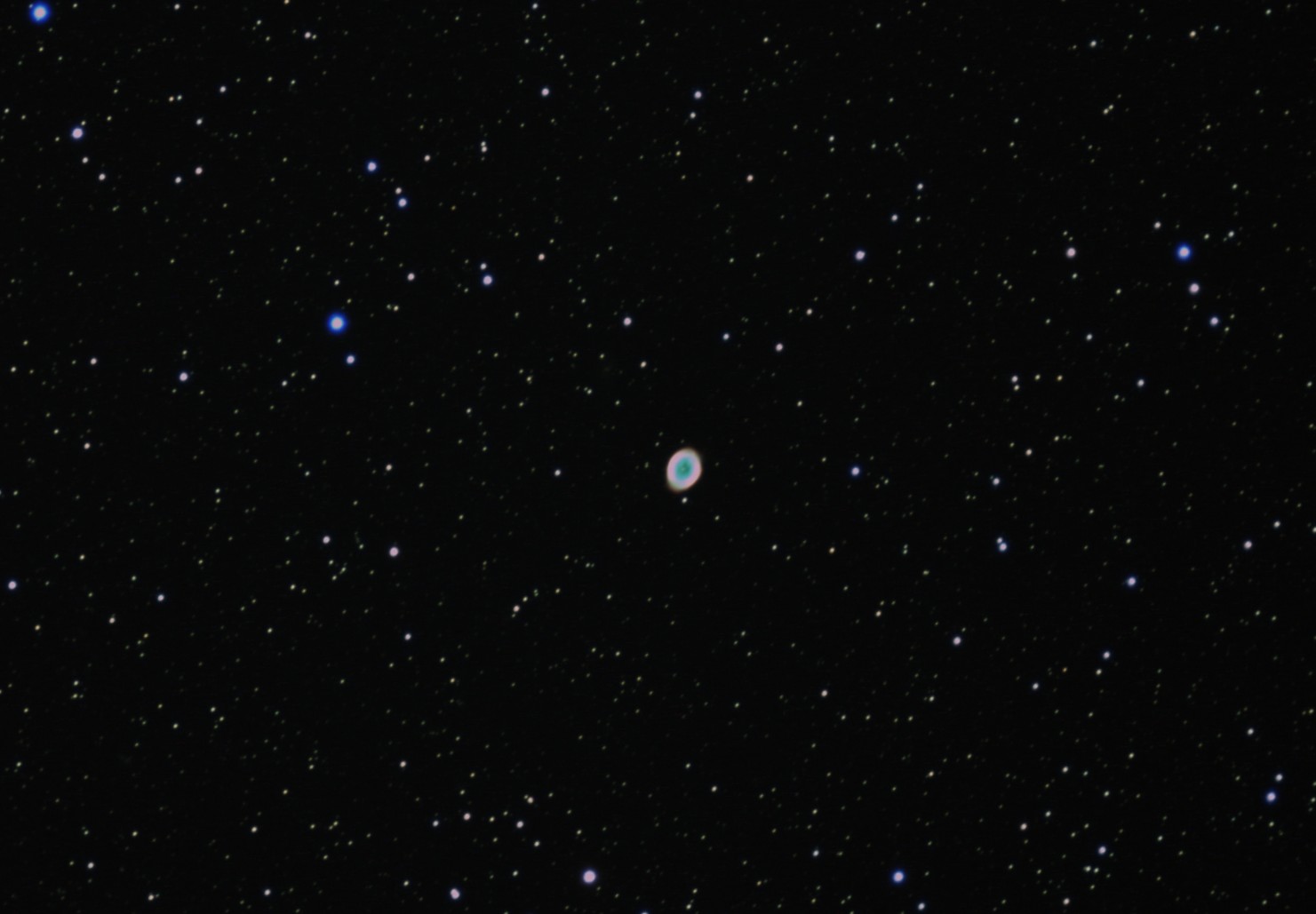
24. M57, Ring Nebula
Notes: M57 lies a thousand light years beyond M27, the Dumbbell Nebula, but it is still close to the Solar System relative to the size of the Galaxy. But it has a faint apparent magnitude of 8.8, so it shows up small at 230 arcsec in our field of view, which is almost 120 arc min. According to Wikipedia:
Even a 7.5 cm (3 in) telescope will reveal its elliptical ring shape [to a viewer]. The interior hole can be resolved by a 10 cm (4 in) instrument at a magnification of 100×. Larger instruments will show a few darker zones on the eastern and western edges of the ring, and some faint nebulosity inside the disk. The central star, at magnitude 14.8, is difficult to spot.
Technical notes: The sky is very clear and the moon has almost set. The guide scope is slightly defocussed. The PHD integration time is set to 0.5. The graph stays within +/- .7 pixel for RA and maybe +/- .5 pixel for DEC. It appears to have more turbulent periods every 3 minutes or so, but it doesn't violate those limits. There are stretches where you might see +/- .5 for RA and +/- .3 for DEC. Zoom in/out with ⌘↑(+/-) (Mac), ctrl (+/-) (PC).