 |
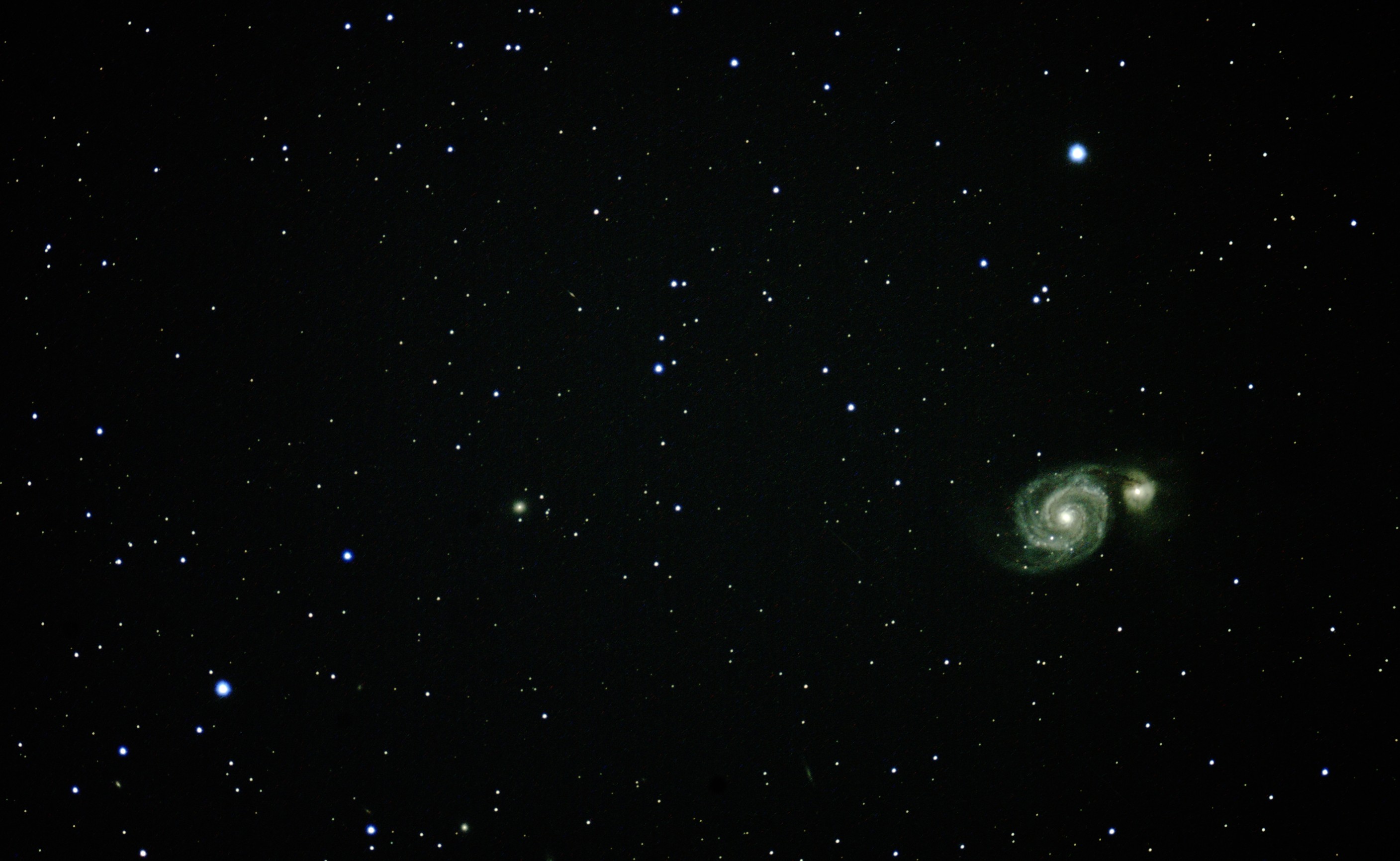
23. M51a, The Whirlpool Galaxy with M51b
Notes: M51 is about the same distance as M101, the Pinwheel Galaxy, but the uncertainty in the distance of 4 million years is startling. If we should receive a radio message from M51, it could have been sent 19 million ya or 27 million ya. There are actually five, and possibly six, galaxies in this image. The most obvious is the fuzzy ball directly west of M51. Two distant galaxies are visible to the southwest (lower left). The possible 6th is also in the SW quadrant.
M51b appears to be pulling some of M51a with it. According to Wikipedia, M51b passed through M51a as recently as 50 million years ago, which would put the event early in the Earth's Eocene geologic epoch of the Tertiary Period, which follows the extinction of the dinosaurs. It was a time when the concentration of carbon dioxide in the atmosphere reached double current levels, temperatures rose, forests grew and were laid down as deposits of coal. The modern mammals emerged.
Imaging: The sky was clear with no breeze. There was a first quarter moon halfway down in the west at 9:30 pm. We adjusted some parameters in PHD. DEC and RA durations were set at 400. We used Auto DEC and Resist Switching and a time lapse of 100 ms. Other values were defaults.
We returned to this image in August 2013 after gaining some experience with Nebulosity. We could now see that the image had black spots that should have been removed with flats. It also had some kind of glare on the left side of the image and very oblong stars on the right side. The image was nice and bright, with good contrast in the spirals, but the central regions of the disks were blown out. We used slightly excessive contrast (a button selection in curves) to obscure the black spots and a bit more suppressing of the lower end of the scale to remove the glare. We were less aggressive in the initial use of levels, so the blown out cores are about half the diameter as formerly. We recropped it to include a line of bright stars and a distant galaxy appearing from the lower left to the upper right and to put M51 off center. The crop also eliminated the oblong stars on the right side. Zoom in/out with ⌘↑(+/-) (Mac), ctrl (+/-) (PC).