 |
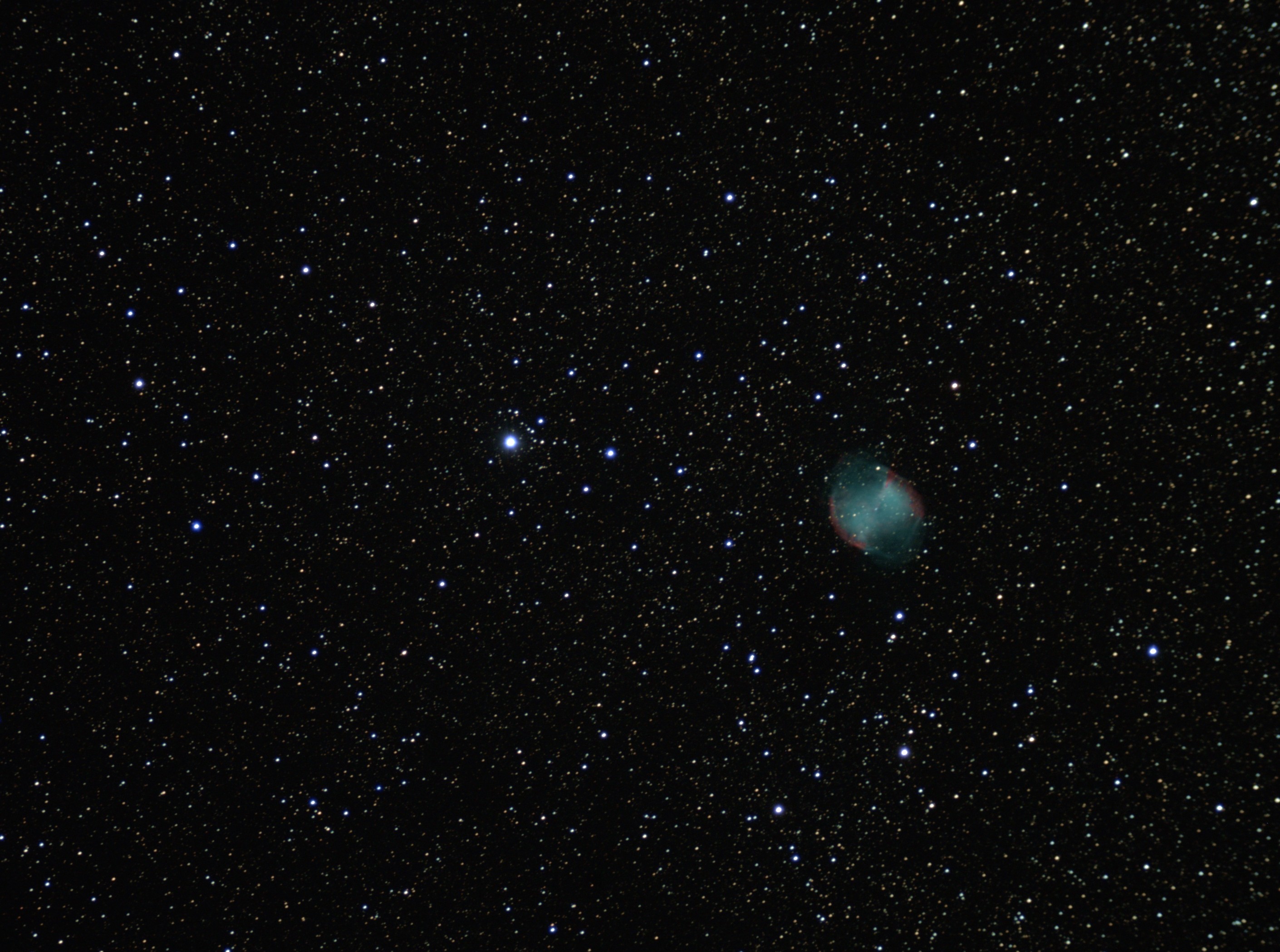
21. M27, Dumbbell Nebula
Notes: M27 is almost the same distance from us as M42, the Orion Nebula (1344 ly). The colors of M27 are produced by the emissions of an exploding red giant star hitting it's own outer layers, which were expelled by pulsations and strong stellar winds (Wikipedia, Planetary Nebula). Thus, it appears that dying star emission nebula would be a better term than the more traditional planetary nebula. Nick Lomb at the Sydney Observatory attempted to determine the true visual colors of M27. He wrote:
On the M27 spectrum the strongest emission lines are those of doubly ionised oxygen (OIII) at 4959 and 5007; the latter saturated the detector! These bands, close to peak human sensitivity, are blue-green — like traffic lights. None of the other bands were as strong as OIII. ... This green-enhanced M27 showed a black sky with mainly white stars (a few orange). Now the nebula was pale green with pink radial jets from the central star (OIII + H-alpha = pale pink). A thin red line edged the nebula's north side where, perhaps, H-alpha is enhanced by collision with slower ejecta. This new image I believe shows M27's true colour — it's green! Yet the bulk of published images do not agree.
The stars in this image do not bear close scrutiny. We are working on it. Zoom in/out with ⌘↑(+/-) (Mac), ctrl (+/-) (PC).