 |
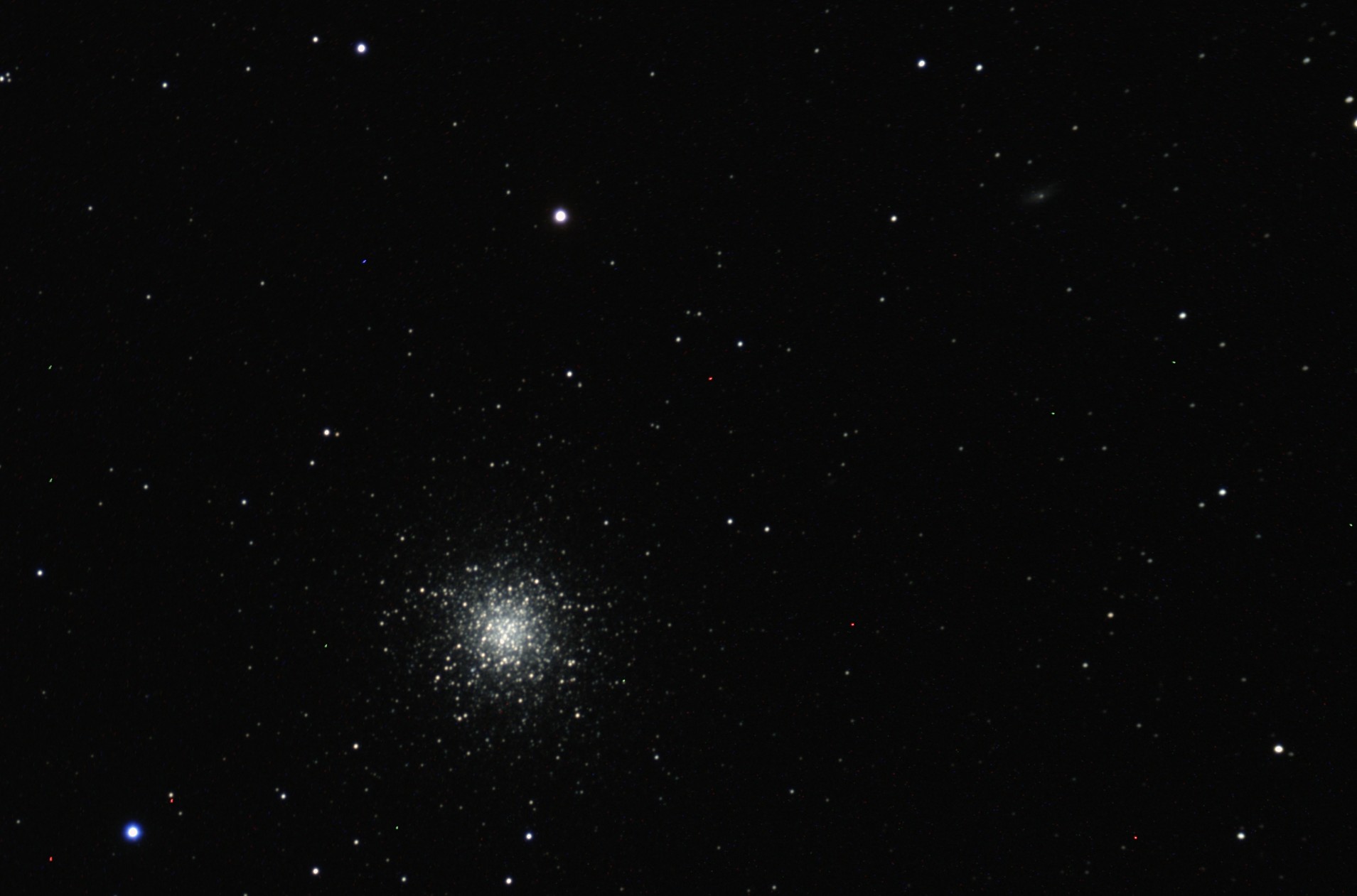
18. M13, Hercules Globular Cluster
Notes: There may be a million stars in this ancient cluster of the Milky Way. Over 150 such clusters have been found in the Galaxy. M13 has an age of 11.65 billion years, which is more than twice the age of Earth. It has a mass of 600,000 Suns but spans only 168 light years, a tiny fraction of the 150,000 ly diameter of the Galaxy. If you were looking for a likely deep space world to colonize, you would probably not go looking in a place like M13. You would go instead to the spiral arms of the Galaxy or Andromeda. In globular clusters, the stars and their planets, are generally old and poor in metals. M13 has less than 1/10 the metallicity of the Sun. Whatever the processes were that generated life on Earth, they would not have much to work with in the planets of M13. And of course, it wouldn't be a great place to stake a mining claim, unless you own a distributorship for helium balloons.
The small, faint galaxy in the upper right quadrant is NGC6207, which is, according to Wikipedia, "a 12th magnitude, edge-on galaxy." It shows up more clearly in (19), but it is in the lower left quadrant of that frame. You may have to zoom in to see it. A larger image of NGC6207 can be seen at the site of the Kopernik Observatory and Science Center. They say "This galaxy has complex knotty spiral arms, faint outer arms, and a bright central lens without a definite nucleus." They measure the distance at 45 million ly, which puts it about 2000 times farther away than M13, as one would expect, because M13 lies in the Milky Way. It is also four times as far as Bode's Galaxy (12) and twice as far as the Pinwheel Galaxy (15, 16). This is obviously too far away for us to distinguish individual stars, so we can be sure that the bright star in the center belongs to the Milky Way. NGC6207 has a diameter of 39,100 ly, which is about one third the diameter of our Galaxy.
For this image of M13, we used longer sub-exposures of 5 min vrs 1 min in (18), and we reduced the iso from 1600 to 800. The histogram was skewed to the right, but the stars in the core did not wash out as we feared they might. Winds reached 11 mph. Zoom in/out with ⌘↑(+/-) (Mac), ctrl (+/-) (PC).