 |
15. M101, Pinwheel Galaxy
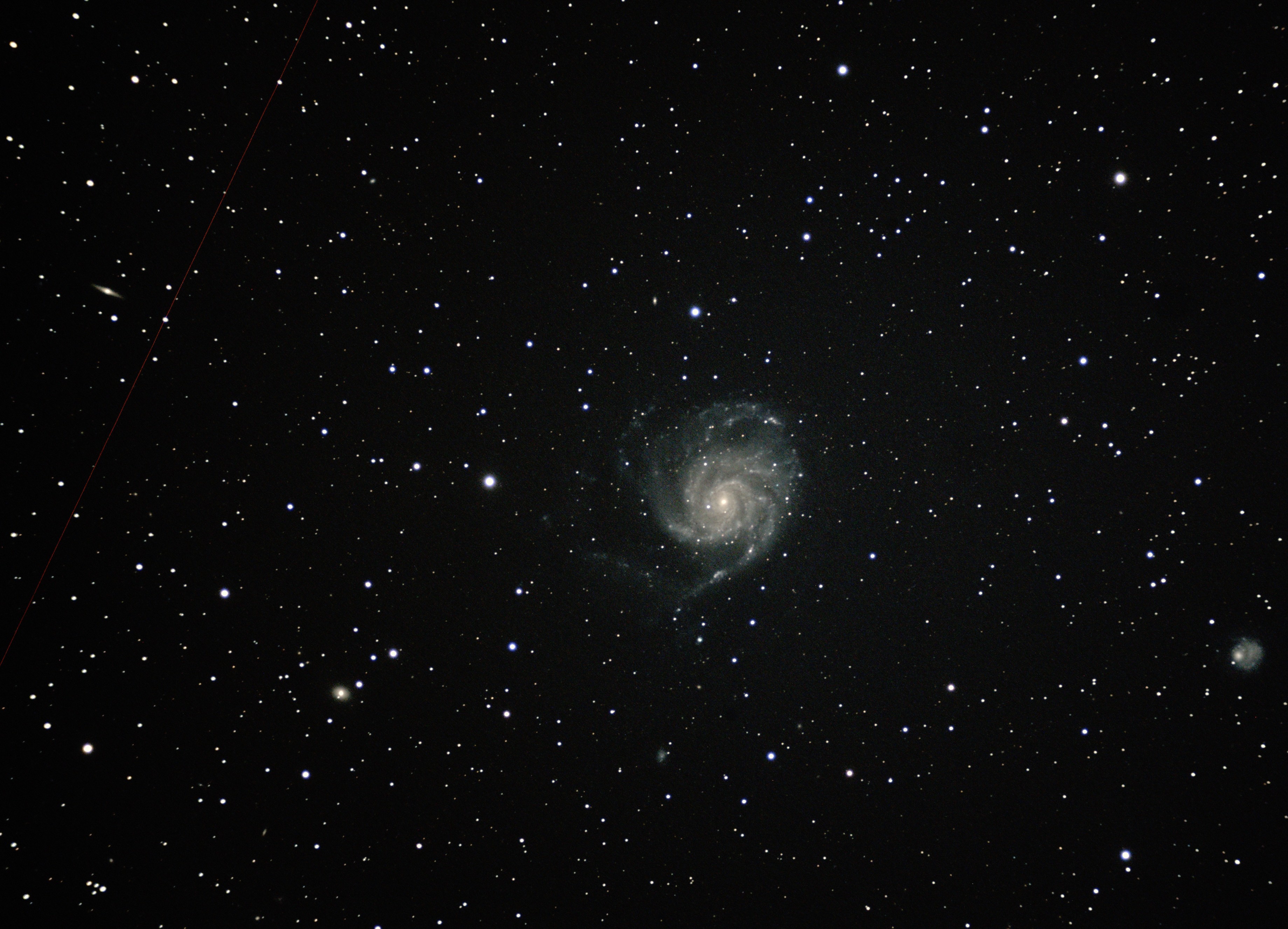
Notes: According to Wikipedia, The Pinwheel galaxy is 70 percent larger than the Milky Way. It lies well outside the Local Group of 51 galaxies, which has a diameter of 10 million ly (Wikipedia). The Pinwheel has a supernova, which appears as a bluish star in the outer spiral at about 2:30, about 20 degrees up from a horizontal drawn through the center. In any galaxy, the oldest stars with the fewest metals are found in the central cluster. Younger stars with more metals and the largest stars are found in the spiral arms, if the galaxy has them (Hoyle, Frontiers of Astronomy, 1966). We can find four other galaxies in this image. They may be among the five companion galaxies of The Pinwheel. The one at about 3:30 may be NGC 5474, as there are hints of a spiral structure.
Due to the great distance of the Pinwheel and the limited light gathering capacity of our scope, this is a challenging subject. We tried to get a good signal to noise ratio by boosting the duration of the subexposures to 17 min. We apparently paid a penalty for that in the form of distorted stars. The galaxy was also in a place near the tipping point of the mount, so several frames were streaky or jaggy. We need more frames and better ones. We ended up with only nine usable frames, which is not enough. See 16 for the sequel. The moon was out early in the evening in a waxing crescent, but it was not a large factor. Several planes passed over on the 20th. One of them, or perhaps a satellite, left the streak on the upper left. Zoom in/out with ⌘↑(+/-) (Mac), ctrl (+/-) (PC).