 |
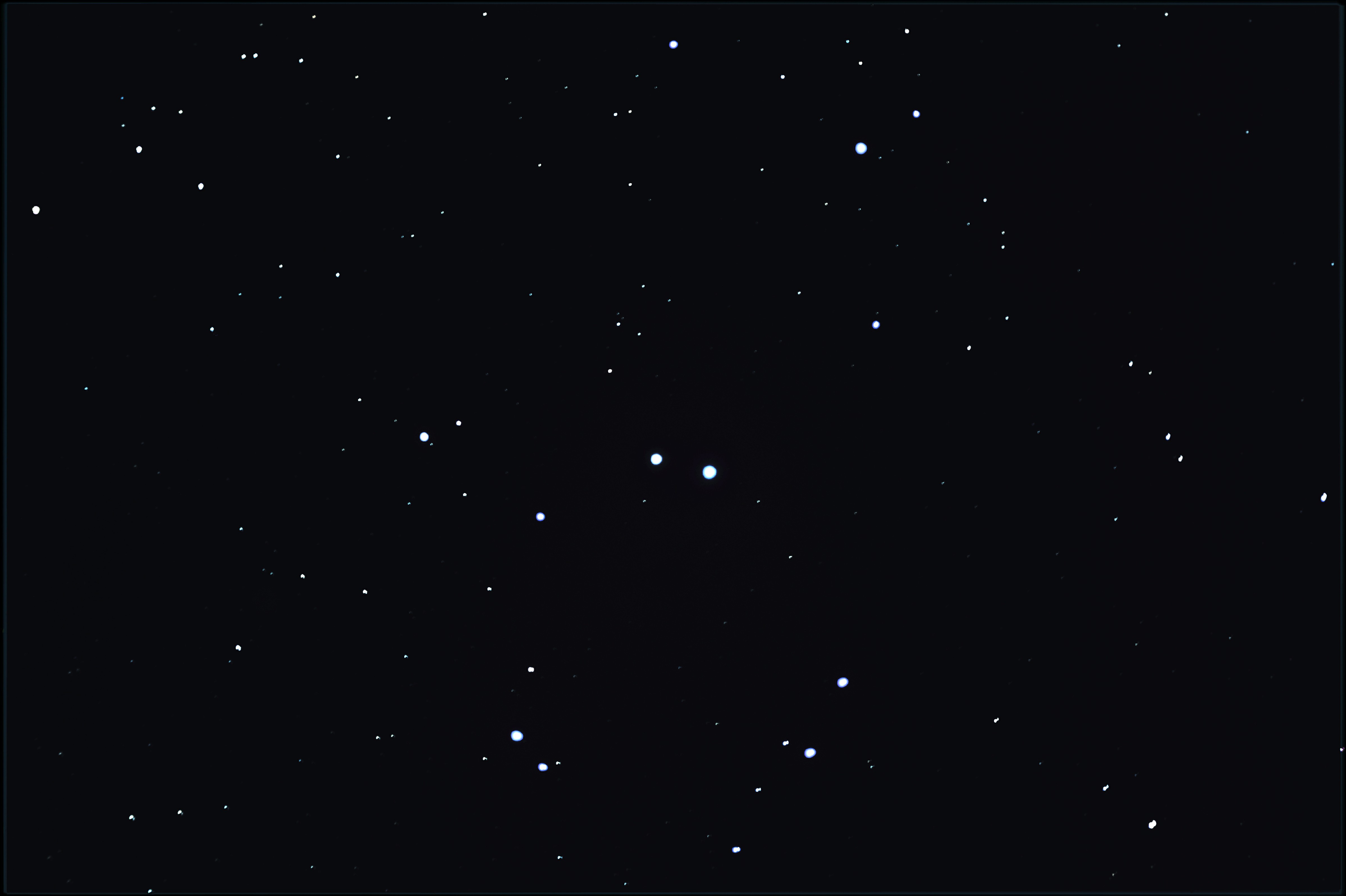
11. Caldwell 41, Hyades Star Cluster
Notes: It's nice to have an image, but this one illustrates several of the things that can go wrong. The moon was very bright and gibbous and perhaps only 40 degrees south of Hyades. There were breezes and thin, drifting clouds. The Hyades are bright with an apparent magnitude of .5. Exposure time of 4 minutes with ISO 400 seemed to give a reasonable histogram, though there were still too many filled pixels. The alignment and calibration seemed good. We had aligned on true north the previous night. The red dot finder makes alignment a vastly easier and quicker process. We used the remote to slew to Hyades. Two bright stars appeared in the EOS Live Shoot screen. Good enough. The individual frames are sharp, but after stacking, the big stars appeared lumpy, and the small stars appeared stretched. Did something go wrong in tracking? Probably not, because that should show up in individual frames. In stacking? What could go wrong there? Is it the moon, clouds, and breezes? At this point, we don't know. Our current theory is that the central piller of the mount was loose.
Prior to photoshopping, we noticed three blemishes in the stack. There was a dark spot above and just left of center. On the flats it appears as a light spot in constant position. We don't know the cause. In the lower right quadrant there was a vertical line of black hatch marks. On the flats, this is a bright spot, probably a star, in shifting position. The flats were taken at pre-dawn. The marks were more apparent in a better viewer such as the Nebulosity display screen than they are in a browser window. There was also a light spot about the same size as the dark spot near the center of the lower left quadrant. It doesn't appear on any of the flats, darks, or lights, so we still have no explanation for it. Perhaps it was somehow introduced in processing.
Wikipedia lists the apparent magnitude of Hyades at 330 arc minutes. The field of view of our SV80 is only 119 arc minutes. Consequently, the image includes only the central sector of the cluster. This is not ideal, but there is an advantage to zooming in: We see more stars per arc second of sky. Zoom in/out with ⌘↑(+/-) (Mac), ctrl (+/-) (PC).