 |
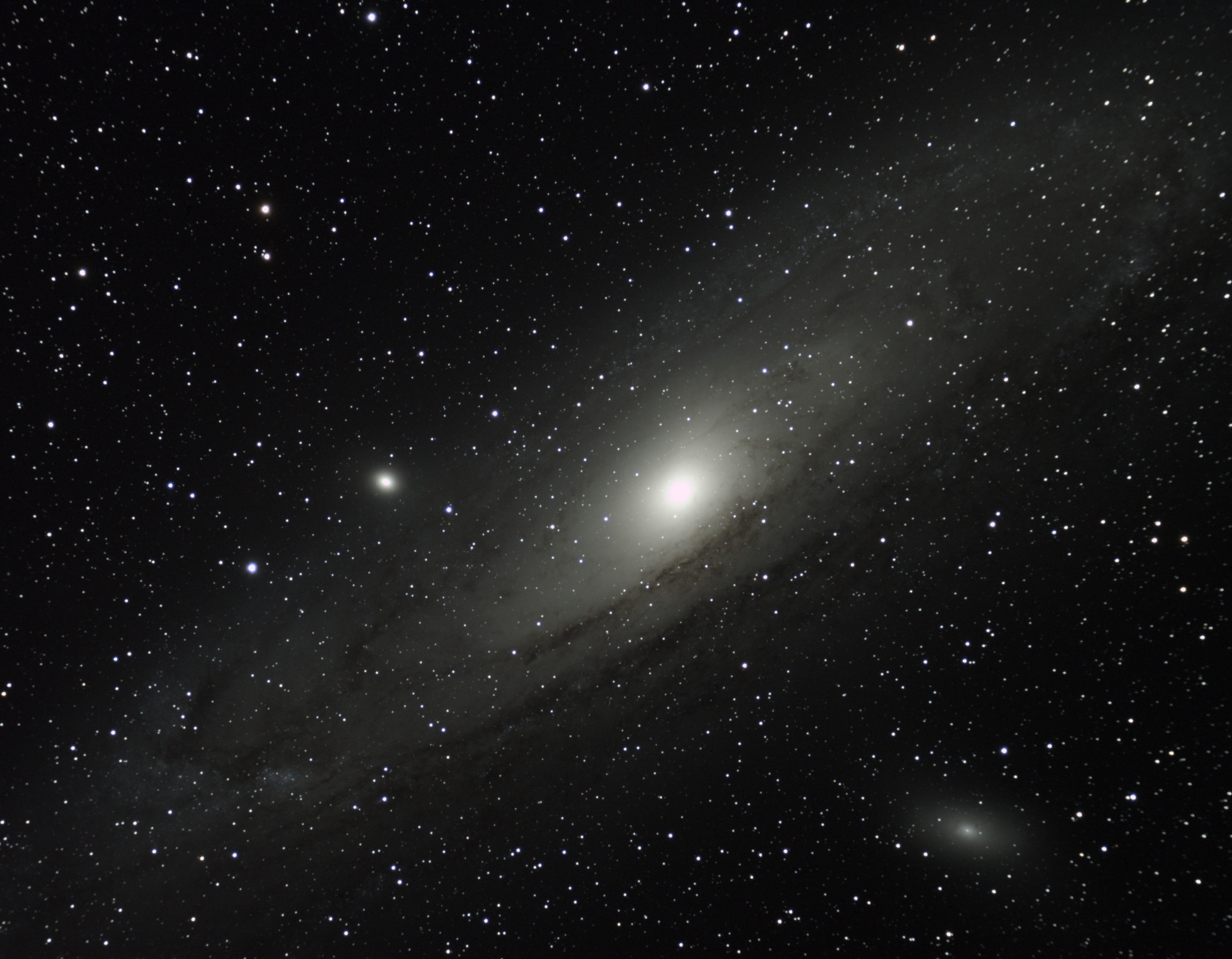
5. M31, Andromeda Galaxy
Notes: Even though exposure times per frame were much longer than figure 4 (10 min. vs. 2 min.), the images showed little visible tracking error. The improvement in tracking comes from putting in more work on polar alignment and getting a good alignment on the Celestial Pole (axis of the Earth's rotation) rather than merely aligning on Polaris. There are more stars and detail than in (1), even though the same exposure times were used. It seems doubtful that the improvement in detail can be accounted for by the two additional exposures. The added detail gives us a better view of M110 , which appears at the lower right of this image. We also get a better view of the black bands of dust in the spirals, and M32 (upper left), which may have passed through Andromeda along the central axis (en.wikipedia.org/wiki/Andromeda_Galaxy). On the minus side, the long exposure times resulted in a histogram that shows high exposures on both the blacks and the whites. The curves tool in Nebulosity was useful for intensifying the middle values. Zoom in/out with ⌘↑(+/-) (Mac), ctrl (+/-) (PC).